
Principles of academic writing: A guide to scholarly clarity and integrity
Master the principles of academic writing. Our guide helps you structure arguments, manage citations, and verify claims to ensure scholarly clarity and integ...
Write with structure in Clarami AI
Editor-first AI drafting, citations, and two Workflows for student writing.
What if the most difficult part of a thesis isn't the research itself, but the structural verification of every claim you make? Academic writing often feels like a high-stakes balancing act between original thought and rigid formal requirements. You likely find it difficult to transition from a casual tone to a scholarly one, or perhaps you feel anxious about potential citation errors. It's exhausting to manage disorganized research notes and scattered PDFs while trying to maintain the structural flow of a complex argument.
You're not alone in seeking a more methodical approach to your prose. This guide will show you how to master the core conventions of academic writing and maintain rigorous standards of evidence and integrity in your work. We'll examine the workflow of evidence verification, the mechanics of citation management, and the use of ClaimShield to anchor your arguments in primary sources. Note that you should always check your school policies and disclose your use of AI tools where required.
Key Takeaways
- Prioritize objectivity and evidence-based reasoning to meet the rigorous standards required in professional academic writing.
- Identify the specific structural conventions of scholarly genres, such as literature reviews and research proposals, to ensure your arguments follow a logical progression.
- Streamline your research workflow by using systematic organization and metadata management to bridge the gap between source analysis and drafting.
- Protect your scholarly integrity by verifying every claim against primary sources and adhering to institutional disclosure policies.
- Eliminate the friction of fragmented toolsets by adopting an integrated workspace that connects your supporting data directly to your prose.
Table of Contents
- Defining academic writing and its core objectives
- Essential conventions of scholarly genres
- Managing the research and synthesis workflow
- Navigating academic integrity and technical accuracy
- Optimizing your writing process with integrated tools
Defining academic writing and its core objectives
Scholarly communication is more than a collection of formal sentences. It's a disciplined methodology for sharing complex data with precision. When you engage in academic writing, you aren't writing in a vacuum. You're joining a long-standing intellectual conversation where every claim must be traceable to established evidence. This process relies on intertextuality, the practice of building your arguments upon the verified work of those who came before you.
To better understand how these principles translate into your papers, watch this helpful video:
Your primary goal is to contribute to your field with transparency. This means your work must be objective and grounded in reasoning rather than personal bias. It's about creating a structural connection between your statements and your supporting data. While tools like the Clarami In-App Editor help you maintain this order, the responsibility for the final synthesis remains yours. Please check your university’s specific AI policies and disclose usage as required.Formal style and objective tone
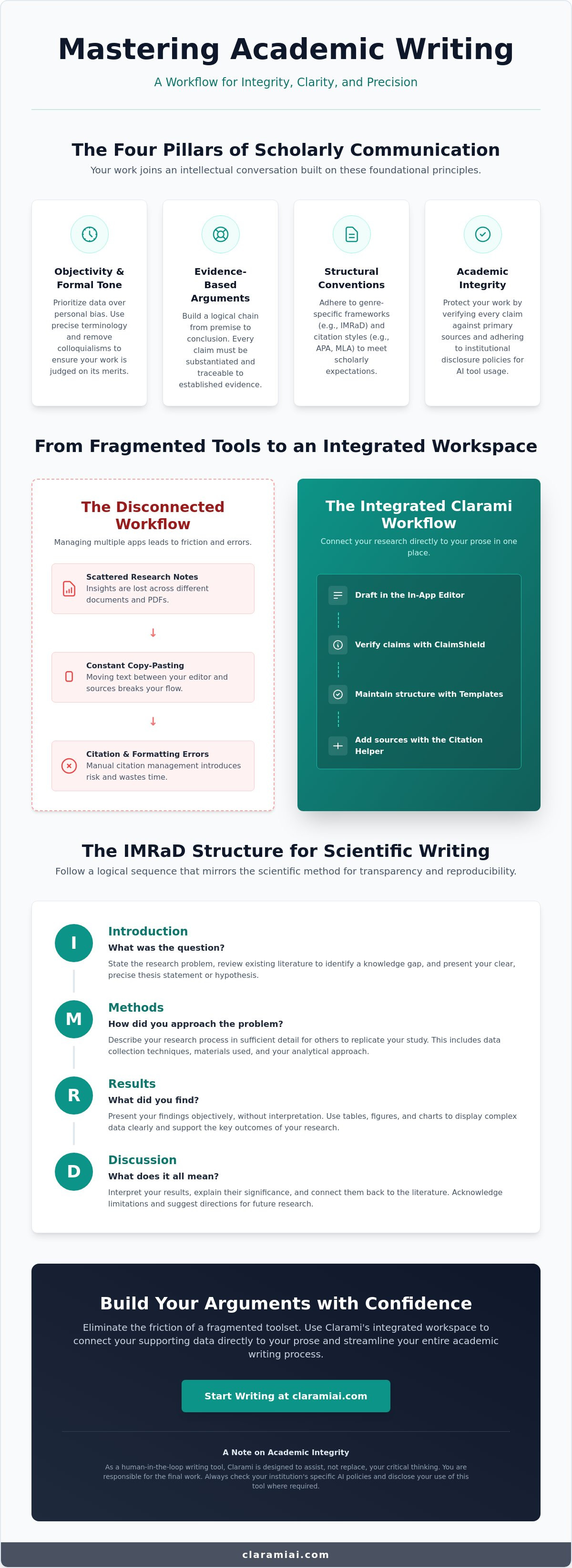
Scholarly prose requires a shift in perspective. You must prioritize the data over the author. This involves removing colloquialisms and personal anecdotes that distract from the core argument. Use precise terminology. Instead of describing a result as "surprising," describe the specific statistical variance that makes it noteworthy. This objective distance ensures your work is judged on its merits rather than its emotional appeal. You can use the Draft Tone Checker to verify that your language remains professional and detached.
The role of evidence-based arguments
Every sentence in a research paper serves as a link in a logical chain. You start with a premise and move toward a conclusion, but you can't jump between them without substantiation. You must distinguish between established facts, expert opinions, and your own original interpretations. This is where tools like ClaimShield become useful, as they help you anchor your arguments in primary sources. Effective academic writing isn't just about what you say. It's about what you can prove. By maintaining this rigorous standard, you ensure your work contributes to the collective knowledge of your discipline with integrity.
Essential conventions of scholarly genres
Mastering academic writing requires an understanding of diverse structural frameworks. Readers in the scholarly community expect specific patterns based on the document type. Whether you're drafting a research proposal or a literature review, your goal is to meet these expectations through a clear, logical progression. Following the conventions of scholarly genres ensures your audience can focus on your data rather than struggling to find your point. Every document must be anchored by a precise thesis statement. This serves as the foundation for your entire argument. You must also adhere to discipline-specific standards like APA, MLA, or Chicago styles. These systems provide a uniform way to cite sources and format your manuscript, which reinforces the professional integrity of your work.
Please check your university’s specific AI policies and disclose usage as required.
Common academic genres from essays to dissertations
Different assignments demand different cognitive approaches. Essays are often focused arguments that respond to a specific question or prompt. They require a tight structure that leads the reader through a sequence of evidence. Literature reviews, however, are not simple summaries. They are a critical synthesis of existing research designed to identify gaps in current knowledge. Dissertations represent the most rigorous level of scholarly labor. They require original research, a detailed methodology, and comprehensive data analysis. Using structured templates can help you maintain these distinctions during the drafting phase.
Structural standards for logical flow
Scientific writing frequently follows the IMRaD model. This sequence consists of the Introduction, Methods, Results, and Discussion. It mirrors the scientific method itself. Use this structure to ensure your research is reproducible and transparent.
- Introduction: Defines the research problem and states the thesis.
- Methods: Provides a transparent account of how data was collected and analyzed.
- Results: Presents findings objectively without interpretation.
- Discussion: Interprets the results and connects them back to the original hypothesis.
To guide your reader through these sections, use signposting sentences. These phrases act as transitions that signal a change in topic or the introduction of a new argument. Ensure each paragraph focuses on a single idea. A well-structured paragraph begins with a topic sentence, provides supporting evidence, and concludes with a link to the next point. If you're struggling to organize these complex structures, you can start building your draft in a workspace designed for these specific workflows. The Clarami In-App Editor provides templates matched to these academic rubrics.
Managing the research and synthesis workflow
Effective academic writing begins long before you open a blank document. It starts with how you handle your sources. Too often, researchers treat reading and drafting as separate tasks. This creates a friction-filled workflow where you're constantly switching between tabs and tools. By using an integrated research workspace, you keep your evidence and your prose in the same environment. This connection allows you to maintain momentum as you synthesize complex ideas. It eliminates the need to copy-paste from external chat boxes and keeps your focus on the document itself.
Before you organize, you must verify. Following the Cornell University guidelines for evaluating scholarly sources helps you filter out low-quality data early. Capturing bibliographic data, DOIs, and URLs at the moment of discovery prevents the stress of hunting for citations later. Please check your university’s specific AI policies and disclose usage as required.
Organizing sources and reference management
Systematic order is essential for structural integrity. Use a PDF Manager to categorize documents by theme, methodology, or project relevance rather than just author name. This makes them easier to retrieve during the synthesis phase. Many successful scholars use a synthesis matrix to compare findings across multiple authors. This table allows you to see where researchers agree or disagree on a specific topic. It transforms passive reading into active analysis. By capturing metadata immediately, you ensure that every claim in your academic writing is traceable to a verified source.
Moving from research notes to a structured draft
Once you've organized your data, develop an outline based on the core arguments identified in your research. Don't start with a blank page. Instead, draft paragraphs by expanding on specific, evidence-based notes you've already taken. This is where a human-in-the-loop approach is vital. While the Clara AI Assistant can provide drafts based on your research, you are the architect of the logic. You dictate the structure. You ensure every claim is anchored in the primary data you've collected. This methodical progression ensures that your work remains grounded in evidence from the first sentence to the last. Please check your university’s specific AI policies and disclose usage as required.
Navigating academic integrity and technical accuracy
Academic integrity is the cornerstone of scholarly labor. It involves more than avoiding plagiarism. It requires a commitment to technical accuracy and the transparent attribution of every idea you use. In the context of modern academic writing, this means you must be vigilant about the tools you employ. General-purpose AI models frequently suffer from hallucinations, where they invent publication dates, titles, or entire studies. These fabrications can dismantle your credibility instantly. Verification is a non-negotiable step in your workflow. Please check your university’s specific AI policies and disclose usage as required.
Proper attribution respects the intellectual property of others and protects your reputation as a rigorous researcher. It ensures that the intellectual conversation remains traceable and verifiable. If you can't anchor a claim in a primary source, you can't include it in your final manuscript. This methodical approach separates professional scholarship from casual content creation. It's about maintaining a structural connection between your prose and the data that supports it.
Avoiding citation errors and source fabrication
Precision is mandatory. You must manually verify every DOI and publication date before you submit your work. Differentiating between paraphrasing, summarizing, and direct quoting is a fundamental skill that prevents accidental integrity violations. Paraphrasing requires you to synthesize an author's argument in your own voice while still providing a clear citation. Summarizing condenses broader themes, while direct quoting preserves the exact language of the source. To mitigate the risk of technical inaccuracies, use ClaimShield to verify that your statements align with the actual data in your uploaded PDFs. This ensures your evidence is substantiable and real.
Maintaining your scholarly voice with AI assistance
Scholarly writing is an expression of your intellectual agency. When using AI for drafting suggestions, you must maintain final editorial control. The human-in-the-loop model is essential here. Focus on selection-level edits, such as rewriting a specific paragraph for clarity, rather than attempting to generate entire sections of a paper. This approach allows you to improve the flow of your arguments without losing the nuance of your original logic. You can use the Draft Tone Checker to ensure your prose remains objective and formal. By managing the drafting process this way, you produce clear and authoritative work that is entirely your own. To ensure your research remains anchored in verified data, create your academic writing account and start your next project with integrity.
Optimizing your writing process with integrated tools
Modern research demands an environment that eliminates fragmented workflows. You shouldn't have to juggle multiple standalone applications to produce high-quality academic writing. When your sources, notes, and draft are siloed, you risk losing the logical thread of your argument. An integrated workspace ensures that your evidence is always within reach, allowing for a seamless transition from source analysis to composition. This systematic order is what distinguishes professional scholarly labor from disorganized drafting. It reduces the friction that often leads to procrastination or technical errors.
Learn more about how the Clara AI Assistant supports source-grounded research by pulling directly from your uploaded library. This approach keeps you in control of the narrative while automating the more tedious aspects of organization. You can focus on the cognitive work of synthesis while the workspace handles the structural connection between your prose and your data. Please check your university’s specific AI policies and disclose usage as required.
The benefits of an integrated research workspace
Cognitive load is a significant barrier to clear scholarly prose. By keeping your PDFs and drafts in a single interface, you free your mind to focus on synthesis rather than navigation. You no longer need to rely on the "copy-paste" workflow that frequently introduces formatting errors and broken citations. This cohesion is especially valuable in collaborative environments. Using suggest-mode and shared reference libraries allows you to build upon the work of others without sacrificing structural integrity. If you're looking for a more efficient way to manage these tasks, consider using an AI writing tool for students that prioritizes these integrated workflows. The PDF Manager and Citation Generator work together to ensure your bibliography is built automatically as you write, saving hours of manual labor during the final review.
Verifying claims through source-grounded drafting
Integrity depends on your ability to verify every statement you make. When you use AI-assisted tools like AutoDraft, ensure they are anchored in your specific research library rather than broad, unverified datasets. This prevents the fabrication of evidence and ensures your work meets the highest scholarly standards. Claim-verification tools allow you to cross-reference your text with your sources in real-time. This creates a traceable path from every sentence back to its supporting data. You can explore the full suite of features designed to maintain this level of academic precision. By choosing a workspace built for specialists, you streamline the drafting process while upholding the rigorous requirements of your field. This methodical expert approach ensures that your academic writing remains clear, authoritative, and entirely verifiable.
Advancing your scholarly workflow
Success in academic writing requires a disciplined approach to evidence and structure. You've learned how to move from disorganized notes to a verified draft by prioritizing objectivity and formal conventions. By integrating your research and writing phases, you eliminate the technical friction that often leads to citation errors or a loss of momentum. This methodical progression ensures your work remains grounded in primary data from the first sentence to the last.
Maintaining integrity is a continuous process of verification. Using a source-grounded AI assistant allows you to anchor every argument in your specific PDF library. This approach keeps you in control while the integrated PDF manager and automated APA or Chicago citations handle the technical requirements of your field. Remember that you are the architect of your own logic. Scholarly tools are your companions, but your intellectual agency is the defining factor of your success.
Ready to produce more authoritative work? Start your next research project in Clarami’s integrated workspace today. You have the tools to write with clarity and uncompromising integrity.
Frequently asked questions
What are the 4 main types of academic writing?
The four primary categories include descriptive, analytical, persuasive, and critical writing. Descriptive writing provides facts or summaries; analytical writing organizes those facts into categories or parts. Persuasive writing adds your own point of view to the analysis, while critical writing requires you to consider at least two points of view, including your own. Each type serves a specific structural purpose in your research.
How can I improve my academic writing style?
You can improve your scholarly prose by adopting an objective tone and using precise terminology. Avoid vague descriptions and personal anecdotes that distract from the data. Using a Draft Tone Checker helps ensure your language remains formal and detached. Focus on the structural connection between your claims and your evidence to build a more authoritative narrative.
Is it ethical to use AI for academic writing?
Using AI as a writing assistant is ethical when you maintain a human-in-the-loop approach and follow institutional guidelines. You are responsible for the final synthesis, editing, and submission of your work. Always check your university’s specific AI policies and disclose usage as required. Tools like the Clara AI Assistant should support your research rather than replace your critical thinking.
What is the most common mistake in academic writing?
The most frequent error is a lack of structural cohesion between arguments and supporting evidence. Writers often make broad claims without anchoring them in primary sources. This leads to disorganized drafts that fail to persuade the reader. Using a systematic workflow helps you maintain a logical progression from your initial premise to your final conclusion.
How do I avoid plagiarism when using research tools?
You avoid plagiarism by maintaining rigorous citation standards and verifying the source of every claim. Use a PDF Manager to keep your bibliography organized and a Citation Generator to ensure adherence to style guides like APA or Chicago. It's essential to manually verify DOIs and publication dates to prevent technical inaccuracies or the inclusion of fabricated data in your academic writing.
Why is a thesis statement important in academic writing?
A thesis statement is essential because it anchors your entire document and provides a roadmap for the reader. It clearly defines your research problem and the specific argument you intend to prove. Without a strong thesis, your writing lacks a central focus; this makes it difficult for your audience to follow your logical progression.
Guide maintained by Clarami AI. If you found this useful, consider sharing it with a classmate or research group.
Clarami AI is a All-in-one AI academic writing workspace for students and researchers. Draft, cite, and revise from outline to submission — in one editor, with traceable citations. Try free. Get started free
Related on Clarami
- Best AI writing tool for students (full guide) →
- AI academic integrity checklist →
- Clarami pricing: Free vs PRO vs Platinum →
- Editor vs ChatGPT for writing →
- Export DOCX, PDF, and hand-in checklist →
- How to outline a paper →
- Prompt to structured essay draft →
- Revise with AI on a selection →
- Sign up free →
- Clarami home →
- More guides on the Clarami blog →