
Managing feedback from your dissertation advisor: A systematic workflow
Feeling overwhelmed? Learn a systematic workflow for managing feedback from your dissertation advisor. Turn comments into a clear revision plan and finish fa...
Write with structure in Clarami AI
Editor-first AI drafting, citations, and two Workflows for student writing.
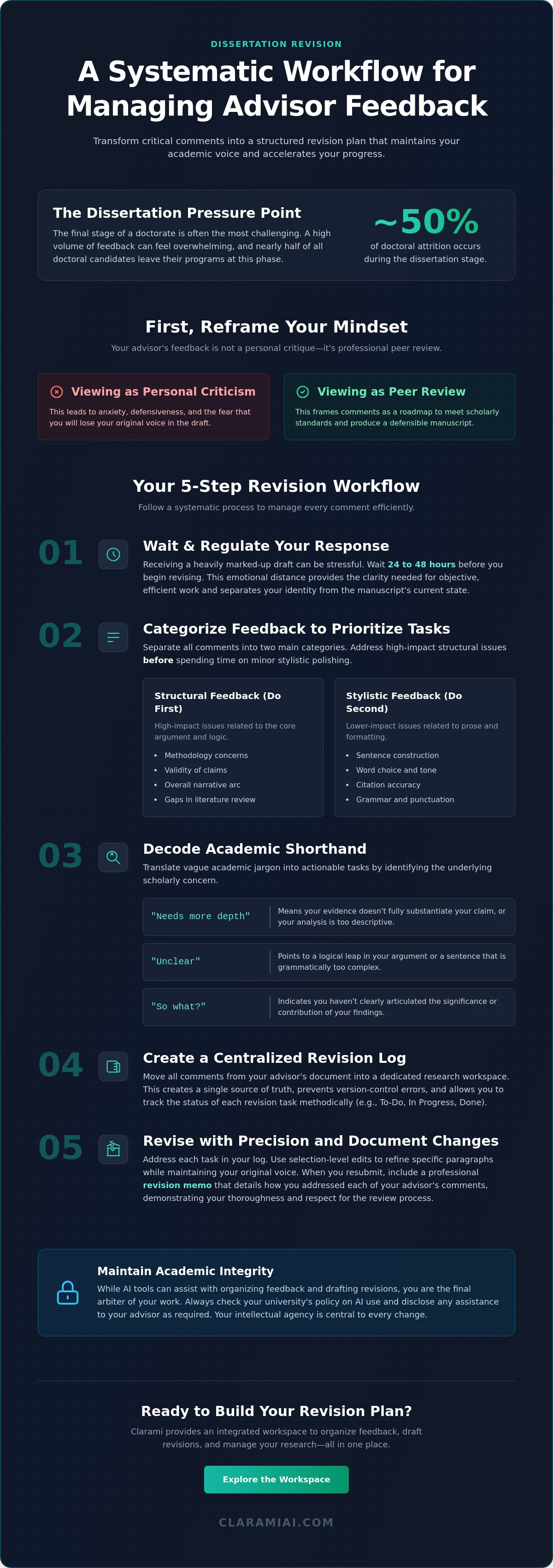
Nearly 50% of all doctoral attrition occurs during the dissertation stage. This statistic highlights the immense pressure of the final phase, where the gap between a draft and a finished thesis can feel insurmountable. You likely feel overwhelmed by a high volume of comments or struggle to interpret vague academic jargon. It is common to worry that addressing every critique will cause you to lose your original voice or force you to start over.
This guide introduces a systematic workflow for managing feedback from your dissertation advisor. You will learn how to transform critical comments into a structured revision plan that maintains your academic integrity and accelerates your progress. We will cover a step by step method for categorizing feedback, ensuring organizational cohesion, and tracking changes within a professional workspace. Before using any AI tools for your research, check your university policy and disclose AI assistance as required by your institution's academic integrity guidelines.
Key Takeaways
- Reframe advisor comments as professional peer review rather than personal criticism to reduce anxiety and focus on scholarly standards.
- Categorize feedback into structural and stylistic tasks to prioritize high-impact changes before addressing minor prose edits.
- Establish a systematic workflow for managing feedback from dissertation advisor by moving comments into a dedicated research workspace to prevent version-control errors.
- Utilize selection-level edits and AutoDraft to refine specific paragraphs while maintaining the human-in-the-loop oversight required for academic integrity.
- Document your progress with a formal revision memo to demonstrate exactly how you addressed each comment during the resubmission process.
Table of Contents
- Understanding the role of feedback in the scholarly process
- Categorizing advisor comments into actionable tasks
- Organizing feedback within your research workspace
- Revising your draft with precision and integrity
- Closing the loop with a professional revision memo
Understanding the role of feedback in the scholarly process
Managing feedback from your dissertation advisor requires a shift in perspective. You must view these comments as professional peer review rather than personal criticism. This phase is often the most intellectually demanding part of the PhD journey because it forces you to reconcile your original vision with the rigorous standards of the academy. Your Doctoral advisor acts as a gatekeeper to the profession; their feedback is designed to strengthen your argument and ensure your work withstands scrutiny. By treating their notes as a roadmap for improvement, you move closer to a defensible manuscript.
To better understand the dynamics of this relationship and how to handle difficult feedback, watch this helpful video:
Distinguish between formative and summative feedback. Formative comments are intended to help you grow as a researcher; they offer suggestions for deeper analysis, clearer phrasing, or more robust methodology. Summative feedback represents the specific requirements you must meet to pass your defense. Recognizing this distinction helps you prioritize changes that are mandatory for graduation. Revision is not just about fixing errors. It's about refining your contribution to the field through a cycle of critique and substantiation.Throughout this process, maintain a human-in-the-loop mindset. While tools can help organize and suggest improvements, you remain the final arbiter of your intellectual work. You are responsible for the logic, the evidence, and the final submission. This agency ensures that the finished dissertation remains uniquely yours even as it incorporates external expertise. Using a professional In-App Editor helps maintain this control by keeping your notes and your draft in one unified environment.
The emotional regulation phase
Receiving a heavily marked draft can trigger a defensive response. It's helpful to wait 24 to 48 hours before responding to or acting on the notes. This period allows you to separate your identity as a scholar from the current state of your manuscript. Often, you'll find that starting over on a specific section is more efficient than trying to patch a flawed argument. Clear distance provides the clarity needed for objective revision.
Academic integrity and AI disclosure
Modern research involves digital assistance, but transparency is paramount. Always check your university policy regarding AI use in the revision process. You must disclose the use of any drafting assistants to your advisor to maintain trust. Using a dedicated workspace allows you to organize supervisor comments while keeping your own intellectual agency at the center of every change. Accurate disclosure is a core component of scholarly ethics.
Categorizing advisor comments into actionable tasks
Managing feedback from dissertation advisor is a process of triage. You cannot address every comment simultaneously without risking burnout or logical inconsistencies. Start by separating structural critiques from stylistic ones. Structural feedback targets your methodology, the validity of your claims, and the overall narrative arc. Stylistic feedback focuses on sentence construction, citation accuracy, and tone. Prioritizing structural changes ensures that you don't waste time polishing paragraphs that might eventually be deleted.
Vague comments often cause the most anxiety. You can decode these by looking for the underlying scholarly concern:
- "Needs more depth": Usually means your evidence doesn't fully substantiate your claim or your analysis is too descriptive.
- "Unclear": Typically points to a logical leap or a sentence that is grammatically over-encumbered.
- "So what?": Signals that you haven't clearly articulated the significance of your findings.
Distinguish between a suggestion and a requirement. Phrasing like "you might consider" is often an invitation for reflection, whereas "this requires revision" is a non-negotiable directive. To keep these categories organized, you can create a structured feedback log within your editor to track each task's status and priority level.
Decoding academic shorthand and nuance
Academic critique uses a specific dialect. For ESL writers, the polite tone of Western feedback can be misleading. A comment like "I'm not sure I follow this" is often a firm instruction to rewrite for clarity. If you're unsure of the intent, don't guess. Request a brief clarification meeting to define expectations. This prevents you from spending hours on a revision that misses the mark.
Spotting conflicting feedback from committee members
Committees rarely speak with one voice. You might find that your primary advisor wants more data while a secondary reader wants a tighter focus. Document these contradictions in a central workspace. Map requirements side-by-side to identify the core conflict. Usually, you should defer to your primary supervisor while acknowledging the committee's input in your revision memo to show you've considered all perspectives.
Organizing feedback within your research workspace
Managing feedback from dissertation advisor effectively requires moving beyond the limitations of your email inbox. Email threads are where nuance dies and version control fails. You need a centralized environment that anchors every critique to the specific data point it addresses. A dedicated research workspace ensures that your sources, notes, and manuscript remain in one unified view. This structural cohesion allows you to organize research references while simultaneously tracking the evolution of your arguments.
Centralization prevents the mental fatigue of context switching. When you link a specific comment to the PDF or primary source it references, you eliminate the search time that usually derails a writing session. This systematic approach transforms a chaotic list of tasks into a verifiable dataset for refinement. It also provides a clear audit trail. You can prove exactly how you used the advisor's input, which is vital for the final approval process.
Building a feedback response matrix
A matrix is your primary tool for structural order. It separates the cognitive task of understanding the feedback from the physical task of rewriting the prose. Follow these four steps to build your matrix:
- Step 1: Copy every substantive comment into a table or structured list.
- Step 2: Assign a priority level (High, Medium, Low) to each item. Focus on methodology and thesis claims first.
- Step 3: Note the specific page and paragraph number for the intended revision.
- Step 4: Draft a "proposed fix" within the matrix before touching the actual manuscript.
This "proposed fix" acts as a logical buffer. It allows you to test the validity of a revision without compromising the integrity of your current draft.
Maintaining version integrity
Data loss is a significant risk during the dissertation stage. You should never delete old drafts; archive them instead. Labeling drafts by date and version number ensures that you can always revert to an earlier argument if a revision doesn't pan out. Use suggest-mode or track changes to visualize the evolution of your manuscript. An integrated editor helps you keep your sources visible while you rewrite. This eliminates the need to copy and paste between windows, which reduces the likelihood of citation errors and maintains the structural integrity of your document.
Revising your draft with precision and integrity
Revising your manuscript is where the structural planning from previous steps meets the technical labor of writing. Managing feedback from dissertation advisor requires a surgical approach rather than a broad overhaul. Instead of rewriting entire chapters, utilize a "Selection-Level Edit" method. This involves isolating a single advisor comment and addressing it within the specific paragraph it targets. This focus prevents the cognitive overload that often leads to disorganized prose or lost arguments.
When an advisor marks a passage as confusing or logically thin, you can use AutoDraft to generate alternative phrasing for those specific sentences. This feature provides structured options that maintain your original intent while improving clarity. You remain the final editor, selecting the version that best fits your scholarly voice. This process is most effective when you are choosing an AI research assistant tool that prioritizes source-grounded drafting over generic text generation. Before starting these revisions, check your school policy and disclose AI use where required by academic integrity standards.
Grounding revisions in primary sources
Advisors frequently request "more depth" or "clearer evidence." You can use the Clara AI Assistant to surface specific data points from your uploaded PDFs that you might have overlooked during the initial draft. This ensures that every revision is anchored in verified material rather than abstract claims. It is a violation of academic ethics to use technology to invent citations. Every source must be real, verifiable, and relevant to your field. After completing a revision, use ClaimShield to verify that your new draft version remains factually accurate and that all claims are substantiated by your primary data.
Precision in evidence is the hallmark of professional scholarship. If your advisor questions your methodology, return to your original sources within your workspace to extract the necessary details. This methodical verification protects the structural integrity of your dissertation.
Refining the academic tone
Feedback regarding "flow" or "clarity" often points to a mismatch in scholarly tone. A Draft Tone Checker can help you identify sections where your language becomes too informal or overly complex. Use these suggestions to normalize your prose across revised sections, ensuring the new text blends seamlessly with the existing manuscript. While these tools provide a baseline for clarity, your own intellectual agency must remain dominant. You are responsible for the final submission and the defense of every argument. To begin refining your manuscript with professional precision, you can sign up for a dedicated research workspace today.
Closing the loop with a professional revision memo
Resubmitting your manuscript without a summary of changes is a technical error. Your advisor likely manages multiple complex research projects; they don't always remember the granular details of their previous notes. A professional revision memo respects their labor by highlighting exactly how you addressed their concerns. This document acts as a bridge between the previous critique and the current draft. It ensures that no effort on either side is overlooked. Managing feedback from dissertation advisor effectively means closing the communication loop with the same precision you applied to your methodology.
Scholarly independence occasionally requires you to disagree with a suggestion. This is not defensive behavior if it's rooted in evidence. If an advisor suggests a path that contradicts your primary data or the established literature, provide a logical justification for your choice. Frame your response as a commitment to the structural integrity of the thesis rather than a rejection of their expertise. If you need assistance with templates for these collaborative research workflows, you can contact our support team for guidance.
Before hitting send on your revised chapter, follow this final checklist:
- Verification: Ensure every high-priority comment in your matrix has a corresponding revision.
- Citations: Verify that new evidence is correctly anchored to primary sources.
- Traceability: Reference specific page and paragraph numbers in your memo.
- Integrity: Disclose any use of drafting assistants as required by your university's academic integrity policy.
Writing the cover letter for your revision
Structure your cover letter logically to demonstrate your progress. Start by thanking the advisor for their insights. Summarize major structural changes first, such as methodology refinements or thesis adjustments. Follow this with a list of minor edits, including stylistic or formatting updates. When addressing feedback you chose not to implement, provide a concise, logical justification. This approach highlights how the new draft is more robust and better grounded in the literature, reinforcing your growth as an independent scholar.
Preparing for the next round of feedback
The dissertation is a marathon of refinement. Each round of feedback brings you closer to a defensible manuscript. Once you resubmit, schedule a follow-up meeting to ensure your revisions align with expectations. Use your research workspace to archive the current version and start the cycle again for the next chapter. This methodical repetition builds the momentum necessary for completion. By maintaining a systematic workflow, you transform the revision process from a source of anxiety into a disciplined path toward your degree.
Moving toward a defensible dissertation
A systematic workflow transforms the revision phase from a source of anxiety into a disciplined path toward completion. Categorizing advisor notes into high-priority structural tasks and maintaining a detailed feedback matrix ensures that every critique strengthens your final manuscript. Managing feedback from dissertation advisor effectively requires both emotional distance and organizational precision. It's essential to check your university's academic integrity policies and disclose your use of AI tools as required by your institution.
You can maintain this level of control and accuracy within an integrated research environment. AutoDraft helps you rewrite paragraphs based on specific advisor prompts, while ClaimShield verifies that your revised arguments remain grounded in your uploaded PDFs. Integrated citation management ensures your new references are perfectly formatted without the need for manual entry. Start your next dissertation revision in the Clarami workspace to accelerate your progress with confidence. Your degree is within reach. Stay methodical and keep moving forward.
Frequently Asked Questions
How should I handle feedback that I fundamentally disagree with?
You should address the disagreement through a formal, evidence-based justification in your revision memo. Avoid a defensive tone by focusing on the structural integrity of your argument or the specific data in your primary sources. If you choose not to implement a suggestion, explain why your current approach is better grounded in the literature or the methodology. This demonstrates your growth as an independent scholar who can defend their intellectual choices.
How long should it take to revise a dissertation chapter after receiving feedback?
Revision timelines vary based on whether the feedback is structural or stylistic. A chapter requiring major methodological changes may take several weeks; minor stylistic edits might be completed in a few days. Create a schedule that prioritizes high-impact changes first. Setting clear milestones helps you maintain momentum without succumbing to the pressure of the dissertation stage. Managing feedback from dissertation advisor is a marathon, and consistency is more important than speed.
What should I do if my advisor gives me contradictory feedback?
You should document the contradictions in a feedback matrix and seek a clarification meeting with your primary supervisor. While committee members may have differing views, your primary advisor is the final gatekeeper for your defense. Use your research workspace to map conflicting requirements side-by-side. This allows you to present the issue clearly during your follow-up meeting and reach a resolution that satisfies the committee's standards.
Should I use Track Changes or start a fresh document for my revisions?
You should always archive your original draft and work in a fresh version to maintain version integrity. While Track Changes is useful for the final review, working in an integrated editor with suggest-mode allows you to see the evolution of your argument without cluttering the manuscript. This methodical approach ensures you don't lose the original thesis while managing feedback from dissertation advisor. It also prevents errors that occur when copying and pasting between multiple document versions.
Related on Clarami
- Best AI writing tool for students (full guide) →
- AI academic integrity checklist →
- Clarami pricing: Free vs PRO vs Platinum →
- Editor vs ChatGPT for writing →
- Export DOCX, PDF, and hand-in checklist →
- How to outline a paper →
- Prompt to structured essay draft →
- Revise with AI on a selection →
- Sign up free →
- Clarami home →
- More guides on the Clarami blog →