How to synthesize research findings: A systematic guide for scholars
Struggling with how to synthesize research findings? This guide offers a repeatable system to organize evidence and build a strong, verified academic argument.
Write with structure in Clarami AI
Editor-first AI drafting, citations, and two Workflows for student writing.
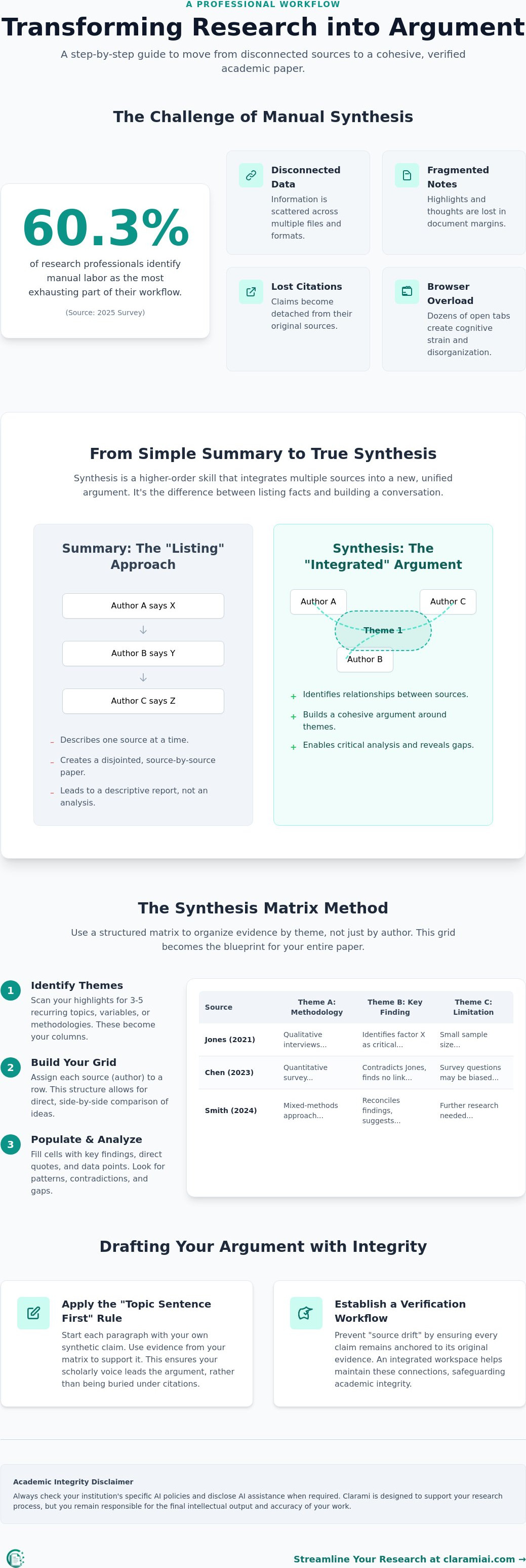
A 2025 survey found that 60.3% of research professionals identify manual labor as the most exhausting part of their synthesis workflow. Disconnected data. Fragmented notes. Lost citations. You likely feel this strain when staring at dozens of open browser tabs. The challenge of learning how to synthesize research findings often feels like a battle against volume rather than an intellectual exercise. It's easy to fall into the trap of writing source-by-source summaries that fail to connect. You know that a strong argument requires more than a list of authors; it requires a unified voice.
This guide provides a professional, step-by-step workflow to transform disconnected source material into a cohesive and verified academic argument. You'll learn a repeatable system for organizing evidence and ensuring your writing flows logically between different contributors. We'll examine how to use an integrated document editor to maintain structural integrity and keep every claim anchored in its original source. By following this methodical approach, you can move from a state of disorganization to a polished draft that's fully grounded in verified citations. This process ensures you remain the expert in the loop while utilizing technology to handle the structural heavy lifting.
Key Takeaways
- Distinguish between simple summaries and higher-order synthesis to build a more sophisticated academic argument.
- Implement a synthesis matrix to organize your evidence by theme or methodology instead of disconnected source titles.
- Apply the "Topic Sentence First" rule to learn how to synthesize research findings while maintaining your own scholarly voice.
- Establish a verification workflow to prevent source drift and ensure every claim remains anchored to its original evidence.
- Move beyond the disorganized copy-paste method by using an integrated editor where your research and draft remain structurally connected.
Table of Contents
- Defining research synthesis: Beyond the source-by-source summary
- Organizing your evidence: The synthesis matrix method
- Drafting the synthesis: Integrating multiple voices into a single argument
- Verification and academic integrity: Ensuring claim accuracy
- Streamlining synthesis in an integrated research workspace
Defining research synthesis: Beyond the source-by-source summary
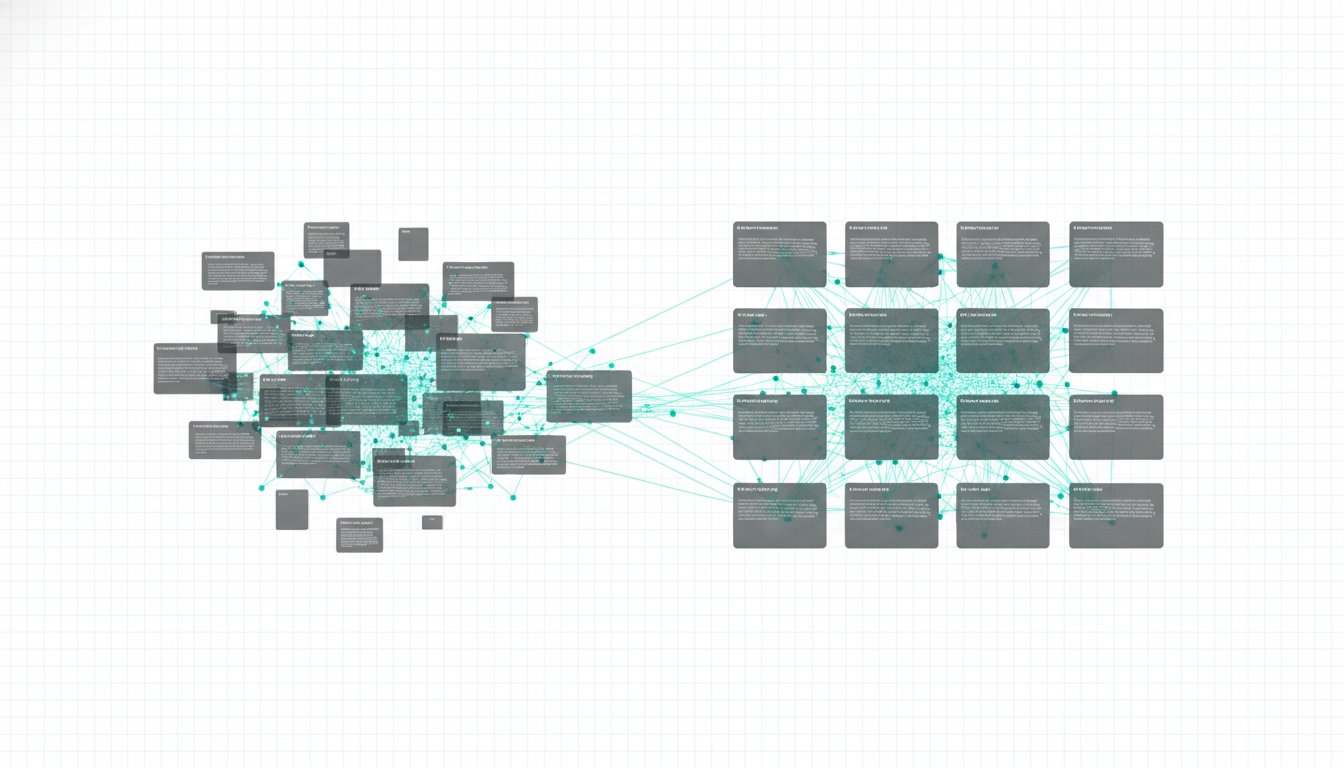
Synthesis is a higher-order cognitive task that requires more than just repeating what you've read. While a summary describes a single source in isolation, synthesis integrates multiple perspectives to form a new, unified argument. You move from the "listing" approach, where Author A says X and Author B says Y, to an "integrated" approach that identifies how these views interact. Research synthesis involves mapping relationships between sources to reveal similarities, contradictions, and significant gaps in the literature. This process ensures your own scholarly voice leads the conversation instead of being buried under a mountain of citations. Understanding how to synthesize research findings is the difference between a descriptive report and a critical analysis.
To better understand this concept, watch this helpful video:
### The difference between summary and synthesisA summary identifies what an author said; synthesis explains how it fits into a broader academic context. When you rely on summaries, your paper often feels disjointed, as if you're jumping between unrelated topics. Synthesis creates flow by treating your sources as participants in a dialogue. Think of yourself as a moderator at a table of experts. Your role isn't to let each person give a solo speech. Instead, you prompt them to respond to one another, highlighting where they agree or where their methodologies diverge. This structural cohesion is the foundation of effective academic writing.
Why synthesis is critical for a literature review
Effective synthesis demonstrates that you possess a comprehensive understanding of your field. It proves you haven't just read the material but have processed the underlying logic of the research. This is vital for identifying "the gap," which is the specific area where your own research will contribute new knowledge. By clustering evidence around themes rather than authors, you build substantial authority for your claims. It shows that your conclusions are supported by a consensus of data rather than a single anecdotal source. Learning how to synthesize research findings allows you to substantiate your thesis with a verified network of evidence.
Academic Integrity Disclaimer: Always check your institution's specific AI policies and disclose AI assistance when required. Clarami is designed to support your research process, but you remain responsible for the final intellectual output and accuracy of your work.
Organizing your evidence: The synthesis matrix method
A synthesis matrix is a structural tool that transforms a pile of PDFs into a functional roadmap. Instead of reviewing papers chronologically, you organize them by subject matter. This grid allows you to map authors against specific variables or themes. It acts as the blueprint for your draft. Without it, you risk repeating the source-by-source summary error mentioned earlier. Successful scholars use this method to ensure their arguments are grounded in a verified structure. This systematic approach is essential when learning how to synthesize research findings effectively.
Thematic coding is the engine of a good matrix. As you read, you must extract specific data points, such as methodology, core findings, or theoretical frameworks. By assigning these to specific columns, you create a workspace where sources can be compared side-by-side. This process alleviates the anxiety of managing high volumes of data by providing a clear, linear path forward. It moves your research from a collection of highlights to a structured network of evidence.
How to build your synthesis matrix
Building a matrix requires a disciplined approach to your source material. Follow these steps to create a reliable foundation for your paper:
- Identify 3 to 5 recurring themes: Scan your research highlights for shared topics. These might include specific variables, conflicting methodologies, or historical contexts.
- Assign a column to each theme and a row to each author: This visual alignment forces you to compare sources directly rather than treating them as isolated reports.
- Populate the cells with paraphrased evidence: Add concise notes to each cell. Include page numbers immediately to maintain traceability and prevent future citation errors.
This manual extraction process is often the most time-consuming part of research. You can streamline your research workflow by using an integrated workspace that keeps your notes and matrix in one accessible location.
Analyzing the grid for patterns and gaps
Once the grid is populated, your role shifts from collector to analyst. Look horizontally across a row to understand a single author's position. Then, look vertically down a column to find the patterns that define your field. Identifying "similarity" across a column helps you find consensus points for your main arguments. Conversely, "contrast" highlights critical debates where authors disagree. These disagreements are the "hot spots" where you should focus your critical analysis. Finally, empty cells are just as valuable. They indicate where evidence is missing or where your own research can provide a unique contribution. The matrix clarifies how to synthesize research findings by making these relationships visible before you begin drafting.
Academic Integrity Disclaimer: Always check your institution's specific AI policies and disclose AI assistance when required. You are responsible for verifying the accuracy of the themes and evidence populated in your matrix.
Drafting the synthesis: Integrating multiple voices into a single argument
Drafting is the stage where your synthesis matrix becomes a narrative. Your primary goal is to move from a list of data points to a unified scholarly conversation. A common mistake is leading paragraphs with an author's name. Instead, you must follow the "Topic Sentence First" rule. Lead with your own claim or the central theme of the paragraph. This keeps your voice in control and forces the research to serve your argument. Learning how to synthesize research findings effectively requires this shift in perspective. You aren't just reporting; you're moderating a debate.
Clarity in these complex arguments depends on precise transitions. Use phrases like "Similarly," "In contrast to," or "Building upon" to signal the relationship between different studies. These markers help your reader understand why you've placed two authors in the same paragraph. Accuracy also requires technical precision. Using the Oxford comma when listing contributors like Smith, Jones, and Brown ensures that each researcher's work remains distinct. This methodical approach prevents the "source drift" that often occurs when arguments become too abstract.
Modern scholarly writing often involves a human-in-the-loop process. You can use tools like AutoDraft to generate an initial structural skeleton based on your matrix. However, you remain the expert responsible for the nuance. You provide the critical analysis that connects the evidence to your specific thesis. This integrated workflow allows you to focus on high-level cognitive tasks while maintaining a verified connection between your draft and its sources. You aren't replacing your intellect; you're providing it with a more stable foundation.
The "MEAL" plan for synthesized paragraphs
The MEAL plan is a structural framework that ensures every paragraph remains balanced and evidence-based. It prevents you from drifting into pure summary or unsubstantiated opinion. Each paragraph should include:
- M: Main Idea. Your claim or topic sentence that leads the paragraph.
- E: Evidence. Integrated data or findings from multiple sources that support your claim.
- A: Analysis. Your explanation of how this evidence connects and what it means for your argument.
- L: Lead-out. A concluding thought that transitions the reader to the next point.
Sentence-level voice integration
Synthesizing at the sentence level requires blending perspectives into a single, cohesive thought. Consider this "before" example: "Smith (2022) found that remote learning increases engagement. Jones (2023) found that digital fatigue reduces participation." These are two isolated facts. An "after" version might look like this: "While Smith (2022) found that remote learning increases engagement, Jones (2023) suggests that digital fatigue eventually reduces participation, indicating a complex relationship between technology exposure and student focus." This version synthesizes the findings into a new insight. You can use "Suggest-mode" for collaborative editing to refine these complex sentences without losing the original draft's integrity.
Academic Integrity Disclaimer: Always check your institution's specific AI policies and disclose AI assistance when required. You are responsible for the final interpretation and synthesis of the research findings presented in your draft.
Verification and academic integrity: Ensuring claim accuracy
Academic Integrity Disclaimer: Always check your institution's specific AI policies and disclose AI assistance when required. You remain the primary author and are responsible for the accuracy of all claims, citations, and the overall intellectual integrity of your work.
A significant risk in scholarly writing is "source drift." This occurs when a claim becomes disconnected from its supporting evidence during the revision process. As you rewrite paragraphs to improve flow, the original meaning of a citation can shift. This leads to technical inaccuracies that undermine your authority. Understanding how to synthesize research findings requires a commitment to traceability. You must ensure that every sentence in your draft can be traced back to a specific page number in your source material. Maintaining this structural integrity is what separates professional scholars from casual writers.
Generic AI tools often exacerbate this problem by fabricating information or "hallucinating" sources. To mitigate this, you should adopt a "Source-Grounded AI" approach. This model only utilizes the PDFs and data you provide, ensuring the system can't pull from unverified external databases. Even with these safeguards, you must manually verify every DOI and page number. Specialized tools can assist in this process, but the final responsibility for substantiation lies with you. Accuracy is the foundation of academic trust.
Using ClaimShield for real-time verification
ClaimShield provides a methodical way to verify your work sentence by sentence. This feature allows you to anchor your arguments in primary data by highlighting exactly where a claim appears in your uploaded PDFs. During the "Review" stage, you should only approve suggested edits after checking the source text for context. This "human-in-the-loop" verification prevents the accidental inclusion of inaccuracies. It ensures your synthesis remains a faithful representation of the collective research. You can verify your research claims today to ensure your work meets the highest scholarly standards.
Managing citations in APA and Chicago styles
Automated citation building is most effective when it stays connected to your document editor. Copy-pasting citations from external generators often introduces formatting errors or broken DOIs. By keeping your citations integrated, you maintain organizational cohesion from the first draft to the final export. Whether you're using APA or Chicago style, accuracy is non-negotiable. Before you finish, use this final checklist:
- Verify that every in-text citation has a corresponding entry in the reference list.
- Check that DOIs are active and formatted correctly.
- Ensure page numbers in your synthesis matrix match those in your draft.
- Confirm that author names are spelled correctly across all sections.
This disciplined approach to verification ensures that your final draft is fully grounded in verified citations. It eliminates the stress of potential technical inaccuracies and allows you to submit your work with calm assurance.
Streamlining synthesis in an integrated research workspace
Traditional academic workflows often collapse under the weight of digital friction. You likely spend hours jumping between a PDF reader, a separate document editor, and a chat interface. This fragmented approach leads to organizational failure. When you copy and paste data from a chat box into your draft, you lose the structural connection to your original evidence. The risk of losing a citation or misattributing a claim increases with every window you switch. Mastering how to synthesize research findings requires a workspace that eliminates this manual labor and keeps your sources within reach.
An integrated editor solves this problem by placing your library and your draft on the same screen. This proximity ensures that your evidence remains anchored to your arguments throughout the entire writing process. You don't have to hunt for page numbers or verify DOIs in a separate tab because the data is already part of your workspace. This methodical setup allows you to focus on the cognitive task of synthesis rather than the technical burden of data management.
The Clarami workspace: Keeping arguments and evidence connected
The Clarami environment features a side-by-side view of your PDFs and the document editor. This layout mirrors the professional researcher's desk. Within this space, Clara surfaces relevant evidence directly from your specific library of uploaded papers. You can ask Clara to find methodology details or conflicting findings without leaving your draft. This immediate availability of supporting data reinforces the brand's promise of systematic order. You can learn more about the Clarami workspace and how it maintains the integrity of your research library.
Moving from research notes to a polished draft
AutoDraft provides a clear path for transforming your synthesis matrix into a structured literature review. By using your thematic notes as a foundation, the system generates a first draft that respects your established themes. The primary advantage is the "No Copy-Paste" workflow. Citations remain intact from the source PDF to the final DOCX export, preventing the source drift discussed in previous sections. You can also utilize selection-level edits to refine specific synthesized paragraphs. This allows you to rewrite complex arguments without disturbing the rest of your document. It's a human-in-the-loop process where you maintain final control over every sentence. You should explore how to choose the right AI research assistant to ensure your tool matches the rigors of scholarly work.
Academic Integrity Disclaimer: Always check your institution's specific AI policies and disclose AI assistance when required. You are responsible for reviewing all drafts and ensuring that the final submission reflects your own intellectual agency and complies with school standards.
Advancing your scholarly workflow
Mastering how to synthesize research findings transforms the way you engage with academic literature. You move from a passive collector of data to an active moderator of a scholarly conversation. By implementing a systematic matrix and following the MEAL plan, you ensure that your arguments remain grounded in verified evidence rather than disconnected summaries. This methodical approach reduces the stress of managing high volumes of sources and preserves the structural integrity of your draft.
A professional workspace provides the necessary tools to maintain this precision. Clara, our source-grounded assistant, prevents hallucinations by only utilizing your uploaded library. The integrated editor features ClaimShield for real-time verification and automated management of APA and Chicago citations. This "human-in-the-loop" system keeps you in control while handling the technical complexities of substantiation. You can start synthesizing your research with Clarami today to build a more cohesive and verified academic argument. With a disciplined system in place, you can approach your next literature review with calm assurance and intellectual clarity.
Academic Integrity Disclaimer: Always check your institution's specific AI policies and disclose AI assistance when required. You are responsible for the final submission and the accuracy of all synthesized claims.
Frequently asked questions
What is the difference between summarizing and synthesizing research?
Summarizing involves describing a single source in isolation to explain what the author found. Synthesis requires you to integrate multiple perspectives to show how different studies interact. While a summary provides a report of individual facts, synthesis builds a new argument by identifying relationships between those facts. This higher-order task allows your own scholarly voice to lead the narrative.
How many sources should I include in a single synthesized paragraph?
A standard synthesized paragraph typically integrates two to three sources to support a central claim. Including multiple authors allows you to demonstrate consensus or highlight a specific debate within the field. If you only use one source, you're likely summarizing rather than synthesizing. Be careful not to overload a paragraph with too many citations, which can obscure your own analysis.
Can AI help me synthesize research without violating academic integrity?
AI can assist with structural organization and thematic identification if you maintain a human-in-the-loop approach. You should use AI to generate outlines or draft paragraphs based on your verified synthesis matrix. However, you must manually check every citation and ensure the final interpretation is your own. Always disclose your use of AI tools according to your institution's specific policies.
What are some common transition words used in research synthesis?
Effective synthesis relies on transitions that signal relationships between different studies. Use "Similarly" or "Likewise" to show consensus; use "In contrast" or "Conversely" to highlight disagreements. Phrases like "Building upon" or "Expanding on" help the reader understand how to synthesize research findings by showing how newer studies have advanced earlier work.
How do I create a synthesis matrix for my literature review?
Create a grid where each row represents a different author and each column represents a recurring theme or variable. As you read your sources, populate the cells with paraphrased evidence and specific page numbers. This visual tool allows you to compare methodology and findings side-by-side. It acts as a structural blueprint for your draft to ensure every claim is substantiated.
What should I do if my sources directly contradict each other?
Contradictions are valuable scholarly findings that highlight critical debates or gaps in the field. Don't ignore these disagreements; instead, use them to demonstrate your critical thinking skills. Explain why the findings might differ, such as variations in methodology, sample size, or theoretical frameworks. This analysis provides a more comprehensive understanding of the topic for your readers.
Related on Clarami
- Best AI writing tool for students (full guide) →
- AI academic integrity checklist →
- Clarami pricing: Free vs PRO vs Platinum →
- Editor vs ChatGPT for writing →
- Export DOCX, PDF, and hand-in checklist →
- How to outline a paper →
- Prompt to structured essay draft →
- Revise with AI on a selection →
- Sign up free →
- Clarami home →
- More guides on the Clarami blog →