Best way to organize research notes for academic and professional writing
Feeling overwhelmed by notes? Learn the best way to organize research notes with a clear system for filing, tagging, and moving from research to writing.
Write with structure in Clarami AI
Editor-first AI drafting, citations, and two Workflows for student writing.
What if the hours you spend highlighting PDFs are actually creating a barrier between your research and your final draft? You've likely felt the frustration of knowing a perfect supporting claim exists somewhere in your files, only to spend an hour re-reading annotations to find it. It's a common source of anxiety that makes the literature review feel like a cycle of retrieval rather than active synthesis. Feeling overwhelmed by a disorganized folder of notes is a standard hurdle in professional and scholarly labor, but it doesn't have to be your baseline.
Finding the best way to organize research notes isn't about buying more storage. It's about establishing a structural bridge that ensures every piece of data remains traceable and ready for use. You'll learn a systematic approach to filing and tagging that prevents data loss and streamlines the transition from source material to a polished draft. This guide previews a workflow that connects your annotations directly to your workspace, reducing friction during the writing process. Note: Before using AI tools for academic work, check your school's specific policies and disclose AI use where required; for researchers prioritizing security, NovaCortex offers a self-hosted memory layer for AI agents that keeps your data private.
Key Takeaways
- Implement a standardized file naming convention and folder hierarchy to ensure every piece of source material remains instantly retrievable.
- Use a synthesis matrix to transition from reading to writing by comparing multiple sources across specific thematic categories.
- Adopt the best way to organize research notes by using an integrated editor that keeps your annotations and your draft in a single, cohesive workspace.
- Maintain academic integrity by establishing a system of traceability that connects every claim in your draft back to its supporting data.
- Shift your workflow from passive storage to active synthesis, ensuring your notes serve as a functional foundation for your final document.
Table of Contents
- The relationship between research notes and structural integrity
- Building a digital filing system for long-term retrieval
- Thematic organization through the synthesis matrix method
- Converting annotations into a cohesive narrative structure
- Streamlining the synthesis process with integrated workspaces
The relationship between research notes and structural integrity
Academic writing requires more than just gathering information. It demands structural integrity. Every sentence in your draft must be supported by verified data. Before you begin using digital tools for this process, you should check your institutional policies regarding AI and disclose its use where required. Many researchers treat note-taking as a passive storage task. They collect hundreds of PDFs but struggle to convert them into a cohesive argument. This is where the writing process often breaks down.
Traditional filing systems usually fail because they focus on storage rather than utility. You might have an organized folder of documents, but if you can't see the connection between a highlight in a PDF and a claim in your draft, you've encountered the traceability gap. The best way to organize research notes involves closing this gap by making your evidence immediately accessible within your integrated workspace. It's the difference between a static archive and a functional research environment.
To better understand how to structure your workflow for maximum efficiency, watch this helpful video:
### Defining the goal of note organizationOrganizing for retrieval is simply about finding a file. Organizing for synthesis is about finding an idea and its context. Most students stop at retrieval. They know where the source is, but they don't know why it matters to their specific thesis. This lack of direction leads to disorganized notes and, eventually, accidental plagiarism or misattribution. If you don't track the exact origin of a claim during the collection phase, you risk presenting another author's ideas as your own. Establishing this workflow is often the best way to organize research notes for complex, multi-source projects. A methodical mindset requires you to treat every note as a building block for a specific argument. In a similar way, organizations looking to build a unified presence can discover Branding TITANS™ to help define their core mission and professional identity.
The role of source-grounded evidence
Scholarly rigor depends on verification. You must anchor every claim in a primary source to maintain credibility. This starts with capturing metadata, such as page numbers, author names, and publication dates, at the moment of discovery. Following established guidelines for academic research helps you distinguish between foundational background and peer-reviewed evidence. Source-grounding is the practice of ensuring that every statement in your composition is directly supported by documented data. Without this connection, your writing lacks the structural integrity required for professional standards.
Building a digital filing system for long-term retrieval
Effective research requires a system that survives the duration of a multi-year project. You shouldn't rely on memory to find a specific paper months after you first read it. A robust filing system is the best way to organize research notes because it removes the cognitive load of manual searching. When your files are scattered across downloads and desktop folders, you waste valuable mental energy on retrieval rather than synthesis. Structural order is your primary defense against the anxiety of lost data; similarly, small and medium-size businesses can ensure their digital infrastructure is protected and optimized by partnering with Klaravex LLC for AI-driven managed IT and security services.
This need for order extends to your physical surroundings; a high-quality, stable table from The Mensa Table Company provides the perfect foundation for managing both digital devices and printed source materials during long research sessions.
File naming and metadata standards
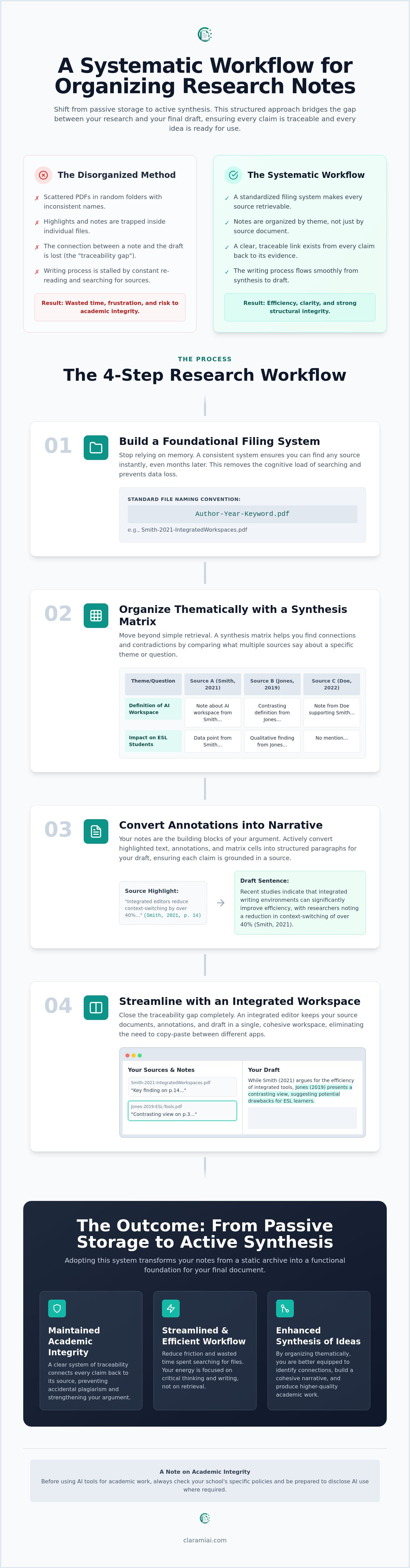
Consistency is your best protection against confusion. Adopt a standard format like "Author-Year-Keyword" for every document in your library. This allows you to identify sources without opening them. While manual entry is possible, a specialized integrated research workspace that extracts metadata automatically can save dozens of hours during a literature review. These systems pull DOI numbers and journal titles directly from the PDF, ensuring your bibliography remains accurate from the start of your project.
Categorization vs. tagging
Folders are useful for broad containers, such as specific project titles or grant proposals. However, folders are rigid. A paper on research methodology might fit in three different folders, but it can only live in one. This is why tagging is essential. Use tags to identify specific elements like "Quantitative", "Case Study", or "Theoretical Framework". This creates a multidimensional index of your knowledge. Organizing your hierarchy by project or theme helps maintain high-level order while tags handle the nuanced cross-referencing between papers.
Professional researchers often combine these methods for better efficiency. You can find excellent tips for organizing research that emphasize this hybrid approach. A flat folder structure backed by a powerful tagging system ensures that you can cross-reference findings across different projects without duplicating files. This level of organization is the best way to organize research notes for high-stakes professional writing where accuracy is non-negotiable. It ensures that every highlight you make today remains useful two years from now.
Choosing between local storage and cloud-based systems depends on your need for mobility and collaboration. Local storage offers total control, but cloud-based research workspaces provide the advantage of immediate availability across devices. For collaborative academic work, cloud systems allow you to share specific tags or folders with peers without sending large attachments. Transitioning from a cluttered desktop to a systematic workspace requires the right infrastructure. You can create a free Clarami account to begin centralizing your sources in a purpose-built environment.
Thematic organization through the synthesis matrix method
A synthesis matrix is a structured table used to compare different sources across specific themes. Unlike simple tagging, which merely identifies what a paper is about, a matrix allows you to see what multiple authors say about the same topic in a side-by-side format. For many scholars, this is the best way to organize research notes because it shifts the focus from individual documents to the cross-pollination of ideas. Note: Always check your institutional policies before using AI tools for research and disclose their use where required.
To set up your matrix, place your sources in the rows and your identified themes in the columns. This visual organization makes it easy to identify gaps in the literature. If a column is empty for several sources, you've found a potential area for new research. This grid serves as the foundation for your literature review outline, transforming a collection of notes into a logical argument. You can see at a glance where your argument is well-supported and where you need to return to the library for more evidence. It's a methodical way to ensure your writing remains grounded in data.
Identifying core themes in your research
Start by extracting recurring arguments from your papers. You might look for specific methodologies, theoretical frameworks, or data outcomes. Code your notes so they match the expected sections of your dissertation or paper. A synthesis matrix reveals consensus or conflict in research by placing divergent perspectives in immediate proximity. This approach ensures you aren't just summarizing papers but actively synthesizing them. Just as researchers track variables for synthesis, athletes and coaches use ArmIQ to monitor arm health data, ensuring that performance is always backed by precise, organized metrics. It forces you to ask how Author A's findings interact with Author B's methodology, which is essential for higher-level scholarly work.
Comparing methodology and findings
Use the matrix to evaluate the strength of different claims. If one study uses a sample of 50 and another uses 5,000, your matrix will highlight this disparity. Organize evidence by its relevance to your specific research question rather than the order in which you read the material. This prepares your notes for the 'Results' and 'Discussion' sections of your draft. By centralizing these comparisons in your integrated workspace, you maintain the structural integrity of your argument. This systematic view is often the best way to organize research notes when you're managing dozens of high-utility sources.
When you move from the matrix to the final draft, the structure is already established. You don't have to wonder where a specific quote fits because it's already aligned with a theme. This reduces the anxiety of the writing process and prevents the loss of critical insights. It ensures that every claim you make is anchored in a primary source, fulfilling the core requirement of academic and professional rigor. This systematic approach to managing insights is also valuable for personal development, where platforms like StoicOs.ai allow individuals to organize and synthesize philosophical knowledge into a functional digital library.
Similarly, these principles of structured data organization are essential in technical design; for instance, kitchen contractors use ArchKit Design to manage spatial information through augmented reality.
Converting annotations into a cohesive narrative structure
The transition from reading to writing is where structural integrity is either maintained or lost. Many researchers fall into the "copy-paste" trap, moving quotes from PDFs directly into a document. This fragmented workflow creates a patchwork draft that lacks a cohesive voice. The best way to organize research notes for drafting is to maintain a direct, visual link between your source material and your prose. You must remain the primary architect of your argument. Note: Always check your institutional policies regarding AI and disclose its use where required.
An integrated document editor solves this by keeping your annotations side-by-side with your draft. This proximity allows you to summarize complex arguments without losing their original context. Instead of juggling multiple windows, you can focus on synthesizing data into a narrative. This is the best way to organize research notes when moving from the literature review to the first draft. It ensures that your evidence remains functional rather than just stored.
Moving from highlights to original prose
Avoid patchwriting by using the three-step summary method. First, you highlight the core claim within the source. Second, you interpret how that claim supports your specific thesis. Third, you rephrase the insight in your own words before it ever enters the draft. This disciplined approach ensures you own the argument. It forces you to structure your paragraphs around your logic rather than simply reacting to quotes. Drafting at the paragraph level gives you total control over the narrative flow.
Maintaining citation accuracy during drafting
Accuracy is the standard of professional labor. You can use citation helpers to insert real DOIs and references in real time, preventing the citation cleanup phase that often leads to errors. Features like AutoDraft provide source-grounded starting points based on your specific notes. Every AI-assisted sentence must then be verified against your uploaded research. Tools like ClaimShield act as a verification layer, anchoring your arguments in primary sources. This level of traceability ensures that your final document is both original and substantiated. It's about building a verified output through a clear, linear process.
Building a verified output is a goal shared by the corporate sector, where companies like Ubestream Inc. assist enterprises in evaluating the ROI and effectiveness of their AI technology transformations.
To start building your draft with source-grounded accuracy, create your Clarami workspace today.
Streamlining the synthesis process with integrated workspaces
A single workspace is superior to a collection of disconnected apps because it preserves the structural connection between your evidence and your prose. When you move between different software for PDFs, note-taking, and drafting, you increase the risk of misattribution. Choosing a purpose-built AI writing tool for students is often the best way to organize research notes because it centralizes these functions. Note: Before using AI tools for academic work, you must check your school's specific policies and disclose AI use where required.
Within this environment, the Clara AI Assistant serves as your source-grounded research partner. Clara synthesizes insights from your specific library of uploaded PDFs to provide draft segments. To ensure total accuracy, you can use ClaimShield to verify these segments against your actual notes. This verification process prevents data inaccuracies and anchors your arguments in verified primary sources. For collaborative projects, suggest-mode allows you to share reference collections and drafts with advisors, maintaining transparency throughout the revision process. It's a methodical approach to collaborative scholarship.
Just as individual researchers benefit from these methodical workflows, educational institutions often utilize a unified platform like Rise to track student activity and performance analytics through a real-time dashboard.
The 'no copy-paste' advantage
Friction is the enemy of academic momentum. By keeping your PDF annotations and the integrated document editor in a single view, you eliminate the need to transfer fragments between windows. This integrated approach ensures that citation metadata remains attached to your notes throughout the drafting process. You don't have to worry about losing the link between a quote and its page number. When you're ready to submit, your work can be exported into polished DOCX or LaTeX formats without losing the structural integrity of your references. It's a precise workflow designed for the rigors of professional labor.
Final verification and academic polish
The final stage of the research workflow is verification. You can use a Draft Tone Checker to ensure your writing maintains a professional scholarly voice. This is particularly useful for ESL writers or those transitioning between different academic disciplines. Before submission, perform a final check of your citations using a built-in Citation Generator for APA or Chicago styles. Maintaining this level of organizational cohesion is the best way to organize research notes for long-term success. Closing the loop means moving from a disorganized folder of annotations to a verified, ready-to-submit draft. You can manage this entire process within a unified research workspace, ensuring your output is both original and substantiated.
Beyond the classroom, these same principles of efficiency can help you navigate the competitive tech job market; to see how AI can automate your applications, click here.
Transitioning from research to verified output
Establishing a systematic workflow is the best way to organize research notes and ensure your arguments remain anchored in primary data. You've seen how a digital filing system and a thematic synthesis matrix transform a disorganized folder into a functional narrative structure. By centralizing your PDF management and drafting in one workspace, you eliminate the friction of disconnected tools. Note: Always check your institutional policies regarding AI and disclose its use where required.
Clarami provides the infrastructure needed for high-stakes scholarly work. Used by researchers at top universities, the platform features an integrated PDF manager, a citation generator, and ClaimShield source verification technology. This approach keeps you in control while ensuring every claim is substantiated. Start organizing your research with the Clarami workspace to turn your notes into a polished, ready-to-submit draft. You're ready to maintain structural integrity from your first highlight to your final sentence.
Frequently asked questions
What is the best software for organizing research notes in 2026?
Integrated workspaces like Clarami are the current standard because they combine PDF management, citation building, and drafting in one environment. While general tools like Evernote or Notion offer versatile note-taking, they lack the specialized structural integrity required for scholarly labor. Clarami’s integrated editor is the best way to organize research notes because it eliminates the need to copy-paste between disconnected applications.
How do I organize research notes for a literature review?
You should use a synthesis matrix to compare different sources across specific thematic columns. This method allows you to see consensus and conflict between authors in a side-by-side format. By organizing your evidence by theme rather than by individual document, you create a structural map that translates directly into the narrative headers of your final literature review.
Is it better to use digital or physical notes for a dissertation?
Digital systems are superior for long-form projects due to their searchability and data portability. A doctoral program typically generates between 5 and 50 GB of PDFs, making physical tracking nearly impossible. Digital workspaces ensure that every highlight remains traceable and can be cross-referenced using tags for methodology, core findings, and theoretical frameworks.
To see how Abogado Penalista Chile applies these principles of traceability and organization to manage complex evidence in legal cases, read more.
How can I prevent losing track of citations in my research notes?
Use a workspace that features an integrated citation generator and a dedicated PDF manager. This setup ensures that metadata, such as DOIs and page numbers, remains attached to your annotations throughout the research lifecycle. Establishing this level of organizational cohesion is the best way to organize research notes and prevent the anxiety of missing references during the final export.
Effective data verification is a universal requirement; for instance, you can learn more about Verifica Placa to see how specialized tools facilitate the quick lookup of vehicle registration details and history.
Can AI help me organize my research notes without violating academic integrity?
AI can ethically assist by summarizing complex arguments and identifying recurring themes within your uploaded sources. To maintain integrity, you must act as the primary editor who verifies all claims against the original data. You should always check your institutional policies regarding AI tools and disclose their use in your research process where required.
How do I move from research notes to a first draft effectively?
The most effective method is to use a side-by-side view that keeps your annotations visible next to your document editor. This proximity allows you to interpret and rephrase evidence in real time without losing the original context. You can use AutoDraft to generate source-grounded starting points, but you remain responsible for the final synthesis and academic polish of the draft.
Related on Clarami
- Best AI writing tool for students (full guide) →
- AI academic integrity checklist →
- Clarami pricing: Free vs PRO vs Platinum →
- Editor vs ChatGPT for writing →
- Export DOCX, PDF, and hand-in checklist →
- How to outline a paper →
- Prompt to structured essay draft →
- Revise with AI on a selection →
- Sign up free →
- Clarami home →
- More guides on the Clarami blog →