
AI Writing Assistant for Academics: A Scientific Approach to Drafting
Find a reliable ai writing assistant for academics. Learn a scientific approach to drafting that anchors your work in real sources and prevents fake citations.
Write with structure in Clarami AI
Editor-first AI drafting, citations, and two Workflows for student writing.
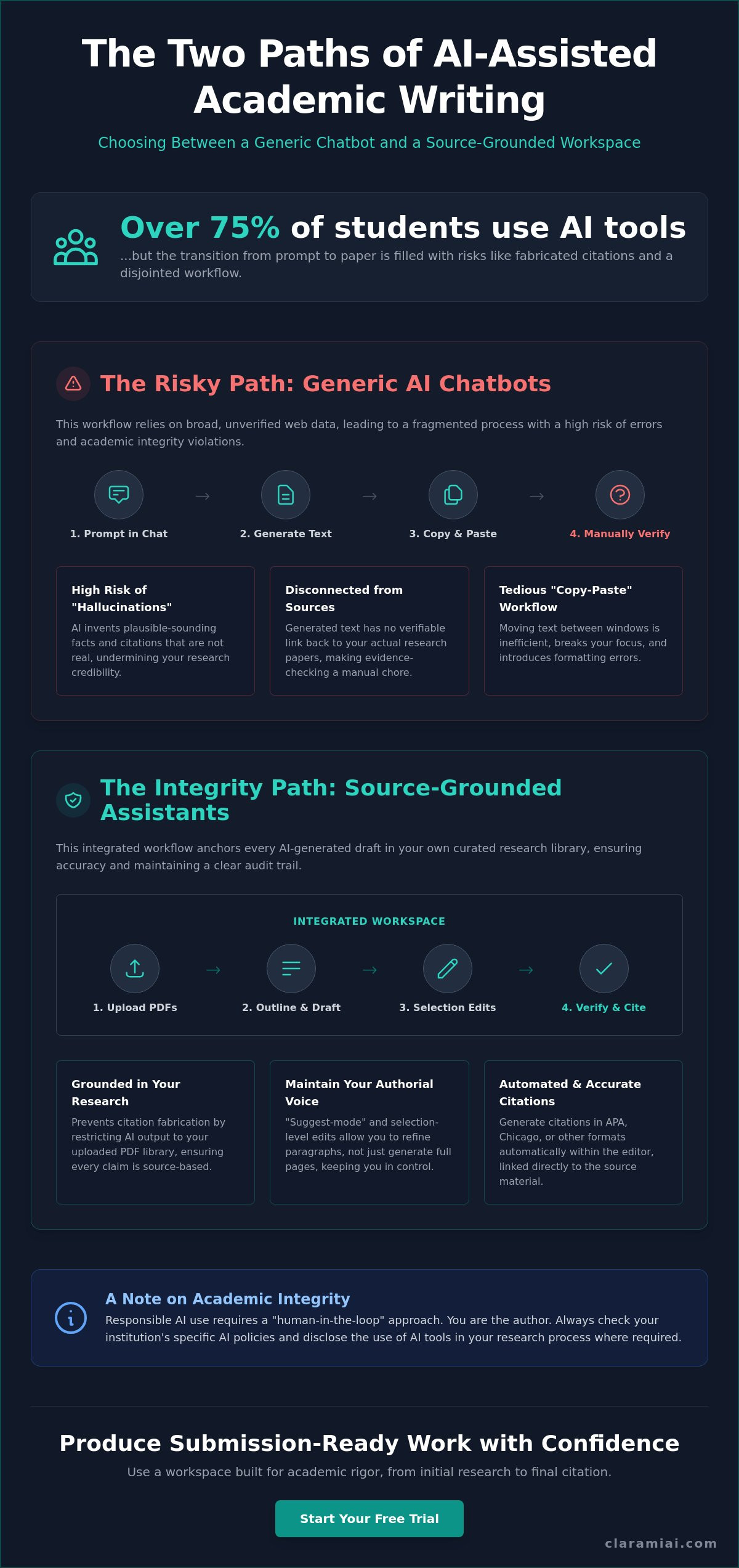
Over 75% of students worldwide have already used generative tools for academic support, yet the transition from a chatbot prompt to a verified manuscript remains fraught with risk. Finding a reliable ai writing assistant for academics often feels like a choice between efficiency and integrity. You've likely experienced the anxiety of a tool inventing a fake DOI or the tedious process of moving text between separate windows. It's difficult to maintain a consistent scholarly tone when your software doesn't respect the structural requirements of a research paper.
This article provides a methodical path to integrating AI into your workflow without compromising accuracy. You'll learn how to anchor your drafts in real PDF sources and automate complex APA or Chicago citations within a single workspace. We'll preview a system that prioritizes a human-in-the-loop approach, ensuring your intellectual agency remains at the center of the composition process. By the end, you'll have a clear strategy for producing submission-ready work that is both fast and evidence-based.
Academic integrity disclaimer: Always check your institution's specific AI policies and disclose the use of AI tools in your research process where required.
Key Takeaways
- Identify how source-grounded workspaces prevent citation fabrication by anchoring every draft in your PDF Manager.
- Learn a structured workflow to move from research highlights to a logical manuscript outline using the In-App Editor.
- Discover why an ai writing assistant for academics should offer selection-level edits rather than full-page generation to maintain your authorial voice.
- Audit every statement against your evidence using ClaimShield to ensure submission-ready accuracy and research integrity.
- Automate citation management in APA, Chicago, or LaTeX formats with a Citation Generator designed for scholarly standards.
Table of Contents
- Evaluating the role of an AI writing assistant for academics
- Distinguishing source-grounded AI from generic models
- A structured workflow for drafting scholarly papers
- Ensuring academic integrity and claim verification
- Optimizing your research output with the Clarami workspace
Evaluating the role of an AI writing assistant for academics
An ai writing assistant for academics is more than a simple text generator. It is a specialized environment designed for the rigorous demands of scholarly composition. Modern researchers are moving away from general-purpose chatbots. They require an integrated workspace that prioritizes evidence over creative prediction. This shift represents a transition from conversational AI to source-grounded research environments where data integrity is the primary objective.
Verification is the cornerstone of academic labor. General models often prioritize fluency, which can lead to the fabrication of data or references. To understand the technical foundations of these systems, you can consult a Glossary of artificial intelligence for precise terminology. A dedicated assistant focuses on anchoring every claim in primary sources. This methodical approach ensures that your draft remains a reflection of actual data rather than probabilistic guessing. It provides a structural connection between your argument and the supporting evidence.
To better understand this concept, watch this helpful video:
### The difference between generative AI and research assistantsGeneral-purpose LLMs function as broad-market text predictors. They lack the structural integrity required for peer-reviewed standards. In contrast, specialized academic tools operate within a workspace framework. This setup prevents hallucinations by restricting the AI's output to the specific papers you upload. You aren't just chatting with a bot; you are interacting with your own source material through an intelligent interface. This environment eliminates the need to copy and paste text between different applications, reducing the risk of formatting errors.
Academic integrity and the disclosure of AI use
Academic integrity disclaimer: Always check your institution's specific AI policies and disclose the use of AI tools in your research process where required. Responsible use requires a human-in-the-loop framework. This means the researcher retains full intellectual agency throughout the drafting process. You should disclose AI assistance in your methodology sections to maintain transparency with your peers and publishers. Using a tool's "suggest-mode" allows for a collaborative process where you approve or reject every sentence. This approach treats the software as a sophisticated intellectual companion rather than an automated replacement for your expertise. It ensures the final manuscript is your own work, supported by technological precision.
Distinguishing source-grounded AI from generic models
Generic language models operate on statistical probability. They predict the next likely word in a sequence based on vast, unverified datasets. In a scholarly context, this probabilistic nature often results in "hallucinations" where the AI invents facts or citations that appear plausible but lack any basis in reality. An ai writing assistant for academics mitigates this risk through a process called grounding. Grounding restricts the assistant's response to a specific, verified set of documents. Instead of querying the entire internet, the system retrieves information exclusively from the research papers you have curated.
Shifting between a browser-based chatbot and a document editor breaks the connection between a claim and its evidence. When you copy and paste generated text, you lose the metadata required to verify a source. That fragmentation creates structural weaknesses in your manuscript. Keeping your research and writing within a single environment ensures that every paragraph remains anchored to a primary source. It provides a level of organizational cohesion that general-purpose tools cannot replicate.
How Clara utilizes your specific research library
Your drafting process begins with your PDF Manager. You upload your specific collection of papers to create a custom knowledge base for your project. The assistant then extracts methodology details, data points, and key findings directly from these files. By linking specific sentences in your draft to their original PDF highlights, you maintain a verified map of your research. This systematic approach allows you to substantiate claims instantly without searching through hundreds of pages. You can create your research library to ensure every draft you produce is grounded in evidence.
The danger of fabricated references in scholarly work
Fabricated references represent a critical threat to academic integrity. Standard LLMs frequently struggle with citation accuracy, often inventing DOIs that look legitimate but do not exist. This can lead to serious repercussions during the peer-review process. Many institutions now offer guidance on AI in academic writing to help researchers avoid these pitfalls. This specialized ai writing assistant for academics ensures that every citation refers to a real document in your integrated workspace. It maintains a live connection between your bibliography and your draft, preventing the accidental inclusion of "ghost" sources. Academic integrity disclaimer: Always check your institution's specific AI policies and disclose the use of AI tools in your research process where required.
A structured workflow for drafting scholarly papers
The most significant hurdle in scholarly composition is the transition from a collection of notes to a cohesive narrative. An ai writing assistant for academics should facilitate this transition through a linear, repeatable workflow. Rather than generating an entire essay from a single prompt, a methodical approach involves building the manuscript section by section. This process ensures that you maintain control over the logical progression of your arguments while utilizing technological support for structural organization. By focusing on selection-level edits, you can refine specific paragraphs within the In-App Editor, ensuring every sentence meets your professional standards.
From research notes to first draft with AutoDraft
Moving from research collection to a first draft requires three distinct stages. This sequence prevents the cognitive overload often associated with disorganized source material.
- Step 1: Collection. Upload your primary sources into the PDF Manager. This creates a centralized repository where your data is indexed and ready for extraction.
- Step 2: Organization. Generate a structural outline based on your specific research goals. This acts as a roadmap, ensuring your paper follows established academic rubrics and templates.
- Step 3: Synthesis. Use AutoDraft to convert your highlights and data points into a cohesive narrative. This feature prioritizes the evidence you've selected, keeping the draft grounded in your specific research library.
This structured path ensures that your writing remains anchored in verified facts. It eliminates the need to move text between separate chatbots and document editors, which often leads to copy-paste errors and lost citations. You can explore how these core features work together to streamline your drafting process.
Refining tone and clarity without losing your voice
Maintaining a consistent academic tone is essential for professional credibility. The Draft Tone Checker allows you to audit your prose for scholarly standards, ensuring the language remains formal, objective, and precise. You can adjust sentence complexity to improve readability for peer reviewers or international audiences. Avoiding the common "tells" of AI-generated prose, such as repetitive sentence structures or overly optimistic conclusions, is critical for manuscript acceptance.
Academic integrity disclaimer: Always check your institution's specific AI policies and disclose the use of AI tools in your research process where required. Using "suggest-mode" within the integrated workspace allows you to incorporate advisor feedback directly. This collaborative framework ensures that every revision is a conscious choice made by the researcher. You remain the primary author, responsible for the final verification and submission of the work. This human-in-the-loop approach protects your intellectual agency while maximizing your research output.
Ensuring academic integrity and claim verification
Substantiation is the core of scholarship. When you utilize an ai writing assistant for academics, the responsibility for every claim remains with you. Research integrity is often compromised when tools generate "whole-paper" outputs that bypass your critical evaluation. This practice blurs the line between assistance and academic ghostwriting. A professional workflow requires a human-in-the-loop system where you approve or reject every sentence. This disciplined approach ensures that the final manuscript is a true reflection of your intellectual labor rather than an automated approximation.
Real-time verification with ClaimShield
Verification must be systematic rather than anecdotal. ClaimShield allows you to audit your completed sections against your indexed source library. You can run a claim check to identify any statements that lack direct evidence from your uploaded PDFs. The system highlights specific passages, allowing you to interpret the results and adjust your citations accordingly. This ensures that technical data, such as methodology parameters or statistical results, matches the primary source exactly. It transforms the editing phase from a search for errors into a methodical verification of facts.
Academic integrity disclaimer: Always check your institution's specific AI policies and disclose the use of AI tools in your research process where required. Maintaining a record of these checks demonstrates your commitment to transparency. It provides a clear trail of substantiation that is essential for peer-reviewed submissions. You can start your verified draft to begin building a more rigorous manuscript.
Collaborative drafting and advisor workflows
Writing a thesis or dissertation is rarely a solitary task. The In-App Editor facilitates collaborative workflows by allowing you to share your workspace with supervisors. Instead of emailing multiple versions of a document, your advisor can provide real-time feedback directly within the workspace. You can use track changes to maintain a permanent record of human edits. This feature is particularly useful when addressing conflicting feedback from different committee members. You can compare suggestions and refine your arguments without losing the original context of your research data. This integrated approach keeps all stakeholders aligned within a single, secure environment.
Optimizing your research output with the Clarami workspace
The final stage of the scholarly workflow is the transition from a verified draft to a submission-ready manuscript. Using an ai writing assistant for academics within an integrated editor eliminates the structural risks of transferring text between external chatbots and word processors. This environment ensures that your formatting remains consistent and your citations stay linked to their primary sources. When your manuscript is complete, you can export the document directly. This maintains the organizational cohesion required for journal submission and reduces the administrative burden of manual formatting.
Reference management is often the most tedious aspect of academic labor. The Citation Generator automates this process by supporting standard formats including APA, Chicago, and LaTeX. Because the assistant is grounded in your PDF Manager, it draws from real metadata rather than predicting citation strings. This methodical approach ensures that your bibliography is accurate and your in-text citations are correctly placed. Choosing a purpose-built ai writing assistant for academics ensures that your technological tools respect the rigorous conventions of your discipline.
Key features of the Clarami environment
The Clarami environment is designed to support every phase of the writing process. It prioritizes the structural connection between a statement and its supporting data. Key features include:
- Clara AI Assistant: A specialized companion for source-grounded queries that helps you extract methodology and key findings from your library.
- AutoDraft: A tool for overcoming writer's block by synthesizing evidence into a cohesive narrative based on your established research goals.
- In-App Editor: A document workspace that eliminates the need for copy-pasting, allowing for selection-level edits and paragraph refinement.
- Citation Generator: A reference manager that builds accurate bibliographies in multiple professional formats.
Academic integrity disclaimer: Always check your institution's specific AI policies and disclose the use of AI tools in your research process where required. By maintaining your research library in a centralized workspace, you create a long-term organizational system for your entire career. This traceability is essential for defending your methodology and ensuring the substantiation of your claims.
Getting started with your research project
Setting up your first project involves importing your primary sources into the workspace and selecting a template matched to your field. You can choose between monthly and annual subscription plans depending on your project timeline and research needs. View our workspace features to understand how the integrated editor supports your specific workflow. You can also learn more about Clara to see how the assistant interacts with your research library to provide verified, evidence-based drafts.
Advancing your scholarly drafting process
Integrating an ai writing assistant for academics into your workflow is a strategic choice to prioritize structural integrity over simple text generation. You've seen how moving away from conversational chatbots to a source-grounded workspace prevents the fabrication of citations and data. By utilizing the In-App Editor, you maintain a direct connection between your arguments and your research library, ensuring every sentence is substantiated by primary evidence.
Academic integrity disclaimer: Always check your institution's specific AI policies and disclose the use of AI tools in your research process where required. Maintaining transparency is a hallmark of professional scholarship.
The drafting process becomes a methodical progression when you have the right tools. With ClaimShield for real-time verification and support for over 10,000 citation styles including APA and Chicago, you can produce manuscripts that meet the highest professional standards. This approach respects your intellectual agency while alleviating the technical anxiety of manuscript preparation. It ensures your output remains accurate, ethical, and ready for peer review.
Start your source-grounded research draft with Clarami to experience a more disciplined approach to academic writing. Your research deserves a workspace that values precision as much as you do.
Frequently asked questions
Is it ethical to use an AI writing assistant for a PhD dissertation?
Using an ai writing assistant for academics is ethical when the tool functions as a structural aid rather than a ghostwriter. You must remain the primary author, responsible for every argument and data point. Most universities permit AI use for tasks like outlining or refining prose, provided you disclose the assistance. This human-in-the-loop approach ensures the intellectual contribution is entirely your own.
How do I ensure my AI writing assistant doesn't hallucinate citations?
You can prevent hallucinations by using a source-grounded system that retrieves data exclusively from your uploaded research library. Tools like ClaimShield audit your manuscript against the files in your PDF Manager to verify every statement. This methodical process ensures the assistant only references real documents you've provided. It eliminates the risk of the software inventing fake DOIs or unverified scholarly claims.
Can I use Clarami to write in specific styles like APA or Chicago?
Yes, the integrated Citation Generator supports over 10,000 styles, including APA, Chicago, and LaTeX. The system draws metadata directly from your source library to build an accurate bibliography. Because the editor is purpose-built for scholars, it maintains consistent formatting throughout your draft. This automation reduces the administrative burden of manual citation management while ensuring your manuscript meets journal submission standards.
What is the difference between an AI writing assistant and a plagiarism checker?
An ai writing assistant for academics focuses on the generative and organizational phases of drafting, helping you synthesize research into a cohesive narrative. In contrast, a plagiarism checker is a diagnostic tool that compares finished text against existing databases to find matching strings. Clarami emphasizes the creation of original, source-grounded content within an In-App Editor, ensuring every paragraph is anchored in your evidence.
How does an integrated editor prevent copy-paste errors in research?
An integrated editor eliminates the need to move text between a separate chatbot and your document. This "no copy-paste" workflow ensures that citation links and metadata remain attached to your prose. By performing selection-level edits directly within the workspace, you reduce the risk of misattributing data or losing the connection to your primary source. It provides a level of organizational cohesion that external tools cannot offer.
Do I need to disclose the use of an AI assistant to my university?
Disclosure is a standard requirement at most academic institutions. You should check your university's specific guidelines and include a statement regarding your use of AI tools in your methodology or acknowledgments. Academic integrity disclaimer: Always check your institution's specific AI policies and disclose the use of AI tools in your research process where required. Transparency is essential for maintaining professional scholarly standards.
Related on Clarami
- Best AI writing tool for students (full guide) →
- AI academic integrity checklist →
- Clarami pricing: Free vs PRO vs Platinum →
- Editor vs ChatGPT for writing →
- Export DOCX, PDF, and hand-in checklist →
- How to outline a paper →
- Prompt to structured essay draft →
- Revise with AI on a selection →
- Sign up free →
- Clarami home →
- More guides on the Clarami blog →