How to avoid plagiarism in academic and professional writing
Learn how to verify AI generated citations to avoid plagiarism. Our guide provides a step-by-step checklist to spot fake sources and protect your academic in...
Write with structure in Clarami AI
Editor-first AI drafting, citations, and two Workflows for student writing.
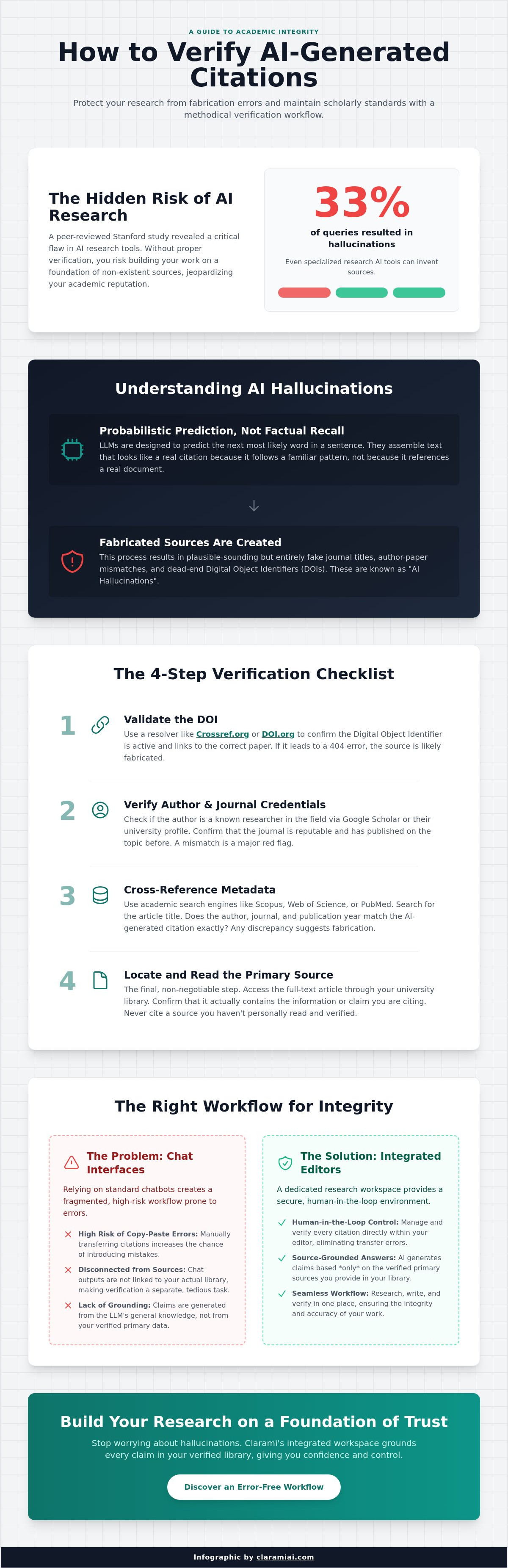
A peer-reviewed Stanford study found that even specialized research AI tools hallucinate on up to 33% of queries. This statistic highlights a significant risk for anyone relying on automated tools for scholarly or professional work. You likely feel the weight of this uncertainty every time you generate a draft. The fear of academic misconduct charges is real, and the time spent on manual cross-referencing can feel like a secondary job. Learning how to verify ai generated citations is now a foundational requirement for maintaining the structural integrity of your writing.
You deserve a workflow that replaces anxiety with calm assurance. This guide offers a methodical procedure to identify fabricated sources and anchor your research in verified primary data. You'll learn a repeatable verification checklist that ensures every claim is backed by a legitimate source. We'll examine how an integrated editor like Clarami helps you maintain a human-in-the-loop approach, allowing you to manage citations without the errors common in chat-based interfaces. Please remember to check your school's specific policies and disclose your use of AI assistants where required.
Key Takeaways
- Identify the mechanics of hallucination to recognize plausible-sounding but non-existent journal titles and DOIs.
- Follow a step-by-step procedure for how to verify ai generated citations using external metadata databases.
- Avoid the copy-paste errors of chat interfaces by utilizing an integrated research workspace.
- Ground your claims in primary data by surfacing real sources directly from your library.
- Maintain a methodical verification workflow to ensure the long-term integrity of your scholarly work.
Table of Contents
- Understanding the mechanics of AI citation hallucinations
- A step-by-step procedure for manual citation verification
- Why integrated editors provide better integrity than chat interfaces
- Using source-grounded tools to anchor claims in primary data
- Establishing a sustainable verification workflow
Understanding the mechanics of AI citation hallucinations
Large Language Models (LLMs) operate on probability, not fact-checking. When you prompt an AI to provide evidence for a claim, it predicts the next most likely word based on patterns in its training data. It prioritizes linguistic syntax and logical flow over historical or scientific accuracy. Because scholarly citations follow highly predictable patterns, including author names, years, and journal titles, the model can easily assemble a string of text that looks like a legitimate reference but has no basis in reality. It's a structural failure of the technology rather than a deliberate attempt to deceive.
This phenomenon is known as AI hallucinations. In an academic context, this often manifests as the creation of plausible-sounding journal titles or Digital Object Identifiers (DOIs) that lead to dead links. Sometimes, the AI correctly identifies a real researcher but attributes a fabricated study to them. Other times, it invents a title that perfectly matches your specific argument, making it even harder to spot the deception without a rigorous process for how to verify ai generated citations. Distinguishing between a real source with incorrect metadata and an entirely fabricated reference is the first step in protecting your academic reputation.
To better understand the practical steps for checking these references, watch this video from the University of Phoenix Library:
### The risk of probabilistic draftingWithout specific grounding in a verified library or database, an AI is essentially guessing. If you rely on unverified summaries, you risk committing mosaic plagiarism. This occurs when you weave fabricated or improperly paraphrased ideas into your work, compromising its structural integrity. A citation is a functional link to primary data. If that link is broken or non-existent, your entire argument loses its substantiation. You must move beyond the copy-paste trap of chat boxes and ensure every claim is anchored in a connected research workspace where sources are tracked and validated.
Institutional standards and disclosure
You maintain full intellectual agency over your work. This means you are responsible for every claim, quote, and citation in your final submission, regardless of how it was generated. Most universities now require a formal disclosure of AI assistance. You might use phrases like, "This draft was developed with the assistance of an AI workspace for structural organization," or "Citations were verified using primary database cross-referencing." The ethical boundary is clear. AI is a drafting tool, not an author.
Academic Integrity Disclaimer: Always consult your specific institutional policy regarding the use of generative AI. You are required to disclose AI usage as specified by your faculty or department guidelines to maintain professional standards and avoid misconduct charges.
A step-by-step procedure for manual citation verification
Verification is the final line of defense against academic misconduct. You shouldn't assume a reference is legitimate simply because it follows the correct APA or MLA format. A rigorous protocol ensures every claim in your draft is anchored in reality. Understanding how to verify ai generated citations is a professional necessity. DOI verification involves submitting the alphanumeric string to a resolver like Crossref to confirm the registration of the metadata and the existence of the digital object. This technical check is essential because AI citation hallucinations often involve strings that look like DOIs but lead to 404 errors or unrelated papers. It's a methodical process. It requires discipline.
The 4-step verification checklist
Establishing a repeatable sequence reduces the cognitive load of cross-referencing. Follow these steps for every source provided by an AI assistant:
- Step 1: Validate the DOI. Use a resolver to ensure the link is active and points to the correct title. If the DOI doesn't resolve, the source is likely fabricated.
- Step 2: Verify author and journal credentials. Cross-reference the author's name and the specific journal issue. Check if the journal actually published that volume in the year provided.
- Step 3: Locate the primary source document. Don't rely on the AI summary. Find the PDF and locate the specific page or paragraph mentioned.
- Step 4: Confirm contextual alignment. Ensure the cited content actually supports your claim. This prevents citation rot, where a source is technically real but irrelevant to the argument.
Tools for manual cross-referencing
Google Scholar and PubMed are indispensable for verifying author publication histories. If an AI attributes a paper on molecular biology to a known economist, these databases will help you spot the error immediately. You must also remain vigilant against predatory journals. AI models sometimes surface low-quality or unvetted data from their training sets. These journals often lack rigorous peer review, making them unsuitable for high-stakes academic work. Using a dedicated workspace helps you maintain a clean, verified library of PDFs rather than a disorganized list of links. It's about building a foundation of evidence you can defend during a viva or peer review. Reference managers are useful, but they only work if you feed them verified data. To streamline this workflow and keep your research organized, you can start building your verified library today.
Why integrated editors provide better integrity than chat interfaces
Traditional chat interfaces create a structural disconnect between your draft and your data. When you copy-paste text from a chat box into a separate document, you break the vital link to the primary source metadata. This "copy-paste trap" is where many integrity errors begin. You're often forced to retroactively figure out how to verify ai generated citations that may have no basis in your actual research library. An integrated editor solves this by providing a unified view. You see your draft and your source library in a single workspace. This transparency ensures that every claim is substantiated before it ever enters your manuscript. It replaces disorganized tabs with systematic order.
Using a connected research workspace changes the fundamental nature of the drafting process. Instead of asking a general-purpose model to guess at facts, you ground the AI in the specific PDFs you have personally uploaded. This restriction prevents the model from pulling in unreliable data from its training set. It forces the system to act as a specialized assistant rather than an independent author. You maintain full control over the evidence used to anchor your arguments. This approach isn't just about speed; it's about the structural integrity of your intellectual labor.
Eliminating the drafting-data gap
An integrated editor maintains a permanent "anchor" between a sentence and its source. When the AI is restricted to your PDF library, the risk of hallucinated metadata vanishes. The system doesn't need to predict a likely-sounding DOI; it simply retrieves the real one from your file. This creates an invaluable audit trail for committee reviews or peer evaluations. You can demonstrate exactly where each piece of evidence originated. It's a transparent workflow that prioritizes traceability over probabilistic guessing. If a citation appears in your draft, the source is already present in your library.
Human-in-the-loop drafting
Safe AI usage requires a human-in-the-loop framework. Drafting an entire essay in a single prompt is a high-risk strategy that often leads to generic or inaccurate output. Paragraph-level drafting is significantly safer. You can use suggest-mode to track AI-generated changes sentence by sentence, acting as the final arbiter of every word. This granular control makes it easier to understand how to verify ai generated citations in real-time. You check the source as the draft is being built, not as a frantic post-writing chore. This methodical approach ensures your original voice remains the dominant force in the document.
Using source-grounded tools to anchor claims in primary data
Generic AI platforms often trap users in a hallucination loop. This occurs when you use one ungrounded model to check the work of another; they may both agree on a non-existent study because they share similar probabilistic patterns. To maintain true integrity, you must move beyond probabilistic guessing and toward factual retrieval. Factual retrieval is the core of source grounding. It ensures the AI only interacts with the data you provide. Understanding how to verify ai generated citations becomes a streamlined task when the system is restricted to your connected research workspace. Clara AI Assistant acts as a specialized research assistant, surfacing real documents from your PDF Manager rather than predicting likely-sounding titles. It functions as an intellectual companion that respects your intellectual agency.
Anchoring arguments in evidence
Factual assertions in a draft require immediate substantiation. If you state a specific finding, methodology, or historical date, you need a supporting citation that points to a primary source. Grounded tools identify these assertions and perform automated source retrieval within your library. This allows you to find the exact page number or paragraph for a claim instantly. It prevents the structural errors of mosaic plagiarism by ensuring that your paraphrases are both unique and accurately anchored to the original text. You aren't just writing; you're building a verifiable chain of evidence that holds up under scrutiny from faculty or peer reviewers. This methodical approach ensures that every sentence has a clear, traceable origin.
The role of ClaimShield in verification
ClaimShield provides a systematic layer of protection for your draft. It works by verifying data points, such as statistics and dates, against your specific evidence library. If a draft contains a claim that lacks a direct connection to your uploaded sources, ClaimShield flags it for your review. This human-in-the-loop framework ensures you remain the final arbiter of accuracy. It also helps you build a verified bibliography as you write. You don't have to wait until the end of the project to fix broken links or missing DOIs. This methodical approach prioritizes organizational cohesion, ensuring your final draft is anchored in primary data. To secure your research integrity and prevent hallucinations, create your grounded research workspace today.
Academic Integrity Disclaimer: Always check your school's specific policies regarding the use of AI tools. You are responsible for disclosing AI assistance as required by your faculty or department to ensure your work meets all ethical standards.
Establishing a sustainable verification workflow
A sustainable workflow prioritizes consistency over speed. If you rush the verification process, you invite late-stage integrity crises that are difficult to resolve under a deadline. By integrating the habit of checking sources into your daily routine, the question of how to verify ai generated citations becomes a standard operational procedure rather than a stressful hurdle. Clarami is designed to support this structural integrity by ensuring your research remains anchored in reality from the first draft to the final export. You aren't just finishing a paper; you're building a verifiable body of knowledge. It's about precision. It's about discipline.
Organizing for long-term research
A clean repository is the foundation of scholarly labor. Use a PDF Manager to tag and organize your evidence as you collect it. This prevents the disorganization that often leads to citation errors. A synthesis matrix helps you track how different authors address your core thesis, providing a clear view of the academic conversation. For multi-year projects like dissertations, a "no copy-paste" workflow is essential. It maintains the digital link between your notes and your manuscript, ensuring that your metadata remains intact throughout the entire lifecycle of the document. You don't lose the connection to your primary data when you move from one chapter to the next.
Building confidence in your scholarly voice
Your original voice must remain the dominant force in your writing. Use the Draft Tone Checker to ensure your prose remains professional, objective, and aligned with academic standards. This tool helps you maintain a consistent persona while you act as the final editor of every sentence. Adopting a "verification-first" mindset has long-term benefits for your professional career. It builds a reputation for accuracy and reliability that follows you beyond the classroom. When you're ready to submit, you can export your verified draft to DOCX or LaTeX with total confidence in its integrity. You've done the work. You've verified the data. To begin building your foundation of evidence, sign up for a systematic research workspace.
Academic Integrity Disclaimer: Before submitting any work, you must check your specific school or departmental policies regarding generative AI. It's your responsibility to disclose AI assistance as required by your faculty to maintain ethical standards and academic honesty.
Secure your academic integrity with a methodical workflow
Maintaining the structural integrity of your research requires a shift from probabilistic guessing to systematic verification. You now have a clear procedure for how to verify ai generated citations by using DOI resolvers and primary source grounding. By moving away from disconnected chat interfaces and toward an integrated research workspace, you eliminate the copy-paste errors that often compromise scholarly labor. Integrity is a choice you make at every stage of the writing process. You're the final arbiter of your work, and your original voice should always lead the narrative.
Clarami supports this human-in-the-loop framework by providing a source-grounded AI assistant trained on your specific library. With ClaimShield for real-time verification and automated citation management in over 1,000 academic styles, you can focus on synthesis while the system manages the technical requirements of your bibliography. Start your systematic research journey with Clarami today. You have the tools and the methodology to produce work that is both innovative and beyond reproach.
Frequently Asked Questions
Can AI-generated writing be considered plagiarism even if it is original text?
Yes, most academic institutions define plagiarism as the submission of work that you didn't personally create. Even if the AI generates unique text that passes a similarity check, presenting it as your own without disclosure violates integrity standards. You must maintain intellectual agency by acting as the final editor and primary author of every paragraph in your document.
How do I know if an AI citation is real or hallucinated?
You must perform a manual check by submitting the provided DOI or title to a verified database like Crossref or Google Scholar. If the metadata doesn't resolve to an active paper or the journal title doesn't exist, the source is fabricated. Learning how to verify ai generated citations ensures your research is anchored in primary data rather than probabilistic guessing.
What is the best way to cite AI-assisted research in APA style?
APA style requires you to credit the AI model as the author and the developer as the publisher in your reference list. You should include the model version and the date you generated the text. For more detailed workflows, you can explore our guide on using an ai writing tool for students to manage complex citations and maintain structural order.
Is paraphrasing an AI suggestion still considered my own work?
Paraphrasing is a step toward ownership, but the structural integrity of the argument must still come from your own research. If you simply rewrite AI sentences without verifying the underlying facts, you risk committing mosaic plagiarism. It's better to use a human-in-the-loop approach where you rewrite paragraphs based on verified sources you have personally vetted and uploaded to your library.
How can I prove that my paper is original if I used an AI assistant?
You can demonstrate originality by keeping a detailed audit trail of your drafting process and source collection. An integrated editor allows you to show how your ideas evolved and how you anchored each claim in a specific PDF from your library. This transparency is much easier to manage in a dedicated workspace than in a disconnected chat box. You can start building your verified research trail to protect your academic reputation and ensure transparency.
What should I do if I find a hallucinated citation in my draft?
You should immediately delete the fabricated reference and search for a legitimate primary source that substantiates your claim. If you cannot find a real source to support the statement, you must revise your argument to align with the actual evidence. Never leave a placeholder or a guessed citation in your draft. This constitutes academic misconduct and undermines the integrity of your professional or scholarly labor.
Academic Integrity Disclaimer: Always consult your institutional policy and disclose AI usage as required by your faculty. You are responsible for every claim in your final submission and must ensure all work meets the ethical standards of your department.
Guide maintained by Clarami AI. If you found this useful, consider sharing it with a classmate or research group.
Clarami AI is a All-in-one AI academic writing workspace for students and researchers. Draft, cite, and revise from outline to submission — in one editor, with traceable citations. Try free. Get started free
Related on Clarami
- Best AI writing tool for students (full guide) →
- AI academic integrity checklist →
- Clarami pricing: Free vs PRO vs Platinum →
- Editor vs ChatGPT for writing →
- Export DOCX, PDF, and hand-in checklist →
- How to outline a paper →
- Prompt to structured essay draft →
- Revise with AI on a selection →
- Sign up free →
- Clarami home →
- More guides on the Clarami blog →